Singapore’s statutory retirement age moved to 64 on 1 July 2026 — and if you weren’t paying close attention, it quietly moved your SRS withdrawal age too.
How your SRS withdrawal age actually gets locked in
Your penalty-free SRS withdrawal age isn’t a fixed number written into the scheme — it’s tied to whatever the statutory retirement age happened to be when you made your first-ever SRS contribution, and then it’s locked for life. If you opened your account and contributed before 1 July 2026, your penalty-free age is 63. Contribute for the first time from 1 July 2026 onward, and it locks in at 64 instead. Once that age is set against your account, a further rise in the statutory retirement age — the government has already flagged 65 by 2030 — won’t move it again.
This is why you’ll see people talk about parking even a small amount into SRS just before a retirement age change — the contribution date, not the amount, is what sets the lock-in.
What happens when you actually withdraw
Withdraw before your penalty-free age, and it’s expensive on two fronts: a 5% penalty on the amount withdrawn, and the full withdrawal counted as taxable income for that year — not discounted.
Withdraw at or after your penalty-free age, and the rules turn in your favour. You can spread withdrawals over up to 10 years from your first withdrawal, and only 50% of each amount withdrawn is subject to tax. Spread out properly against your other income in retirement, this is where SRS earns its keep as a tax-planning tool, not just a savings account.
Contribution limits, while we’re at it
Singapore citizens and PRs can contribute up to $15,300 a year; foreigners, who don’t get CPF tax relief, get a higher cap of $35,700. There’s no ceiling on how much can sit in the account overall — only on how much goes in each year.
SRS isn’t a substitute for CPF LIFE — or the other way round
People sometimes compare SRS to CPF LIFE or to a private annuity from an insurer like Income (formerly NTUC Income), but they’re solving different problems. CPF LIFE is a mandatory, government-backed lifelong payout — it can’t be withdrawn as a lump sum and generally out-pays a private annuity for the same premium, precisely because it isn’t run for profit. SRS is the opposite: entirely voluntary, self-directed, and flexible on timing — you choose what it’s invested in and when you draw it down within the rules above. Most retirement plans I put together use SRS to fill the gap CPF LIFE leaves — the years before CPF LIFE starts, or on top of it — rather than treating either as a replacement for the other.
If you’re not sure whether your SRS contributions, timing, and withdrawal age actually line up with the rest of your retirement plan, get in touch and I’ll go through it with you. You might also want to read how I approach retirement planning more broadly.
Most Singaporeans I meet have a retirement number. A CPF LIFE payout, a rental yield, a portfolio drawdown figure. It is usually thoughtful, sometimes spreadsheet-perfect. And almost every one of them has built it on a quiet assumption: that healthcare will cost roughly what it costs today. It is the single most expensive assumption in Singaporean retirement planning, because medical costs in retirement do not behave like anything else in your budget.
That assumption is the probably single largest unfunded liability in Singaporean retirement planning. Here is why — and what to do about it.
Before we go further, one question. When your last Integrated Shield Plan renewal notice arrived, did the number give you a jolt? If it did, you are not imagining it and you are not alone — and the reasons run a great deal deeper than one year’s increase.
Part One: How We Got Here
To understand where your premiums are going, you have to understand how the system was built.
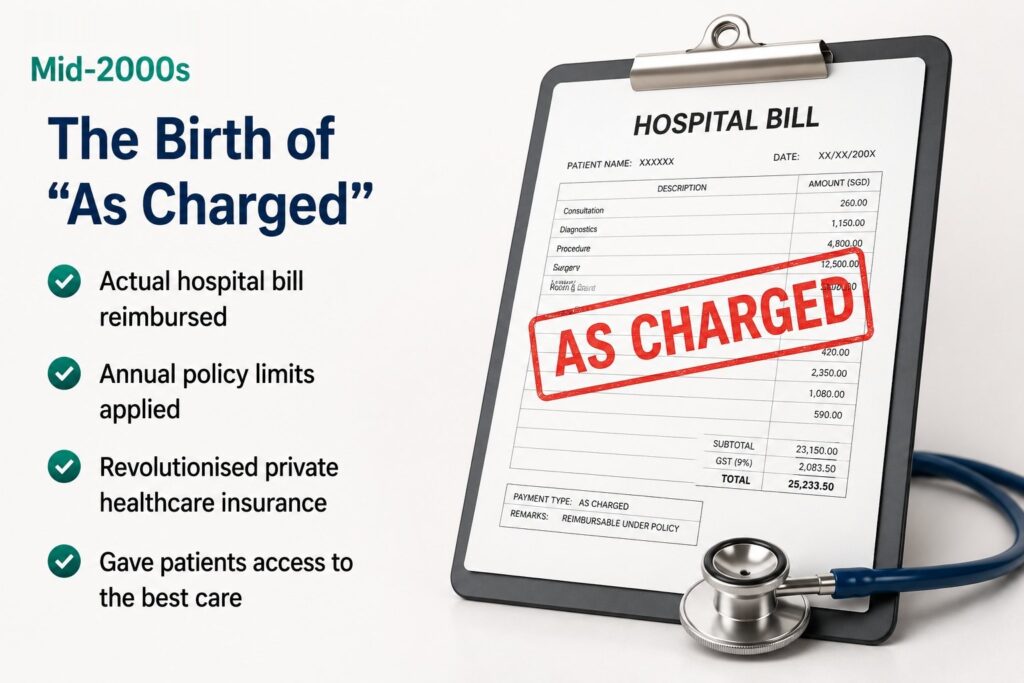
2005 — The “as charged” revolution. Aviva brought the first “as charged” Integrated Shield Plan to Singapore in 2005, removing the inner limits that had previously capped what could be claimed for each procedure. Later, it extended as-charged coverage to outpatient dialysis and cancer treatment.
Competitors matched within months. Inner limits — the old discipline mechanism — largely disappeared for private-hospital plans. It was a genuine breakthrough for policyholders — and it also removed the ceiling on what a hospital bill could be.
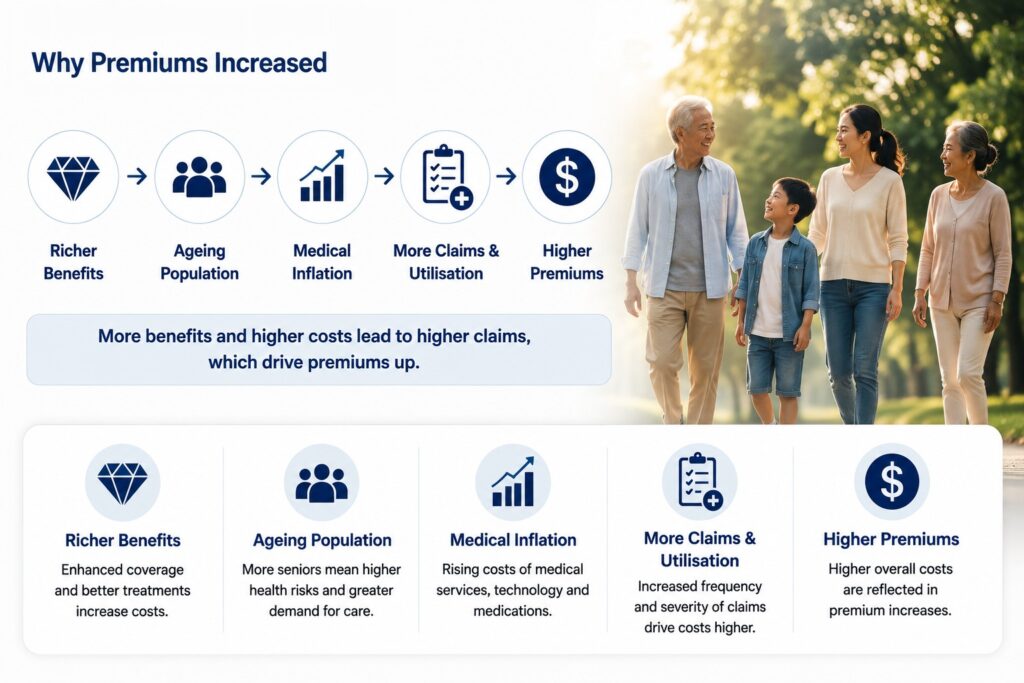
Other insurers enhanced their plans with richer benefits, longer pre- and post-hospitalisation coverage and access to private hospitals.
Consumers benefited tremendously.
However, richer benefits also meant that patients became less sensitive to healthcare costs, while hospitals and specialists invested in newer technology and increasingly sophisticated treatments.
2007–2015 — full riders and the buffet problem
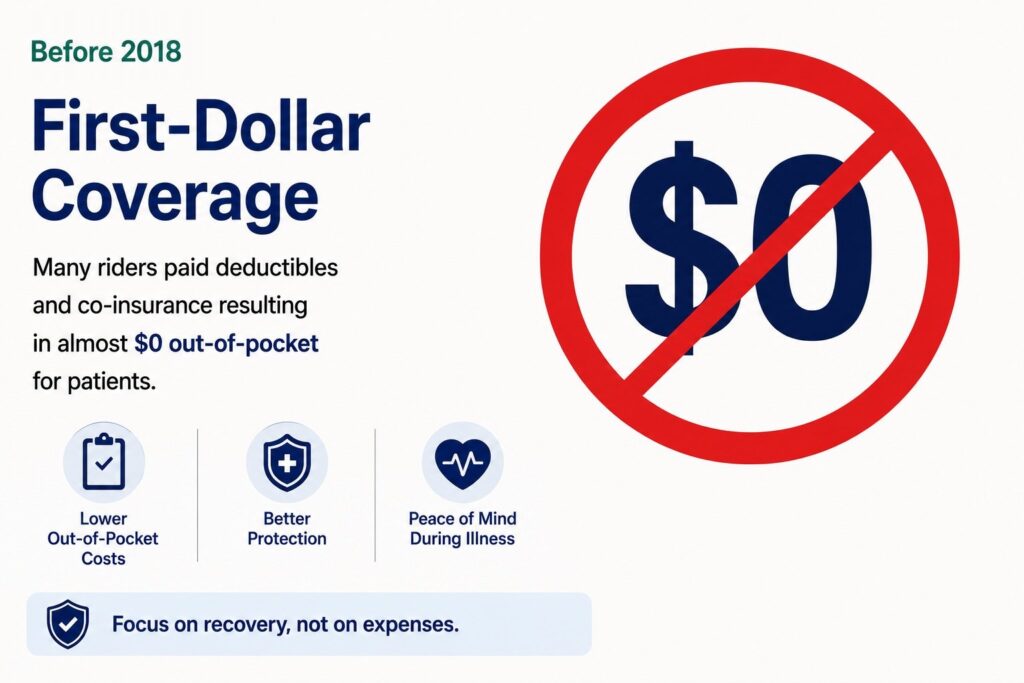
Insurers layered on riders covering both deductible and co-insurance, producing near-zero out-of-pocket hospitalisation. Senior Minister of State Chee Hong Tat later described this as a “buffet syndrome,” leading to over-consumption, over-servicing and over-charging. Insurers then layered on riders that absorbed the deductible and co-insurance entirely. Hospitalisation became, almost free.
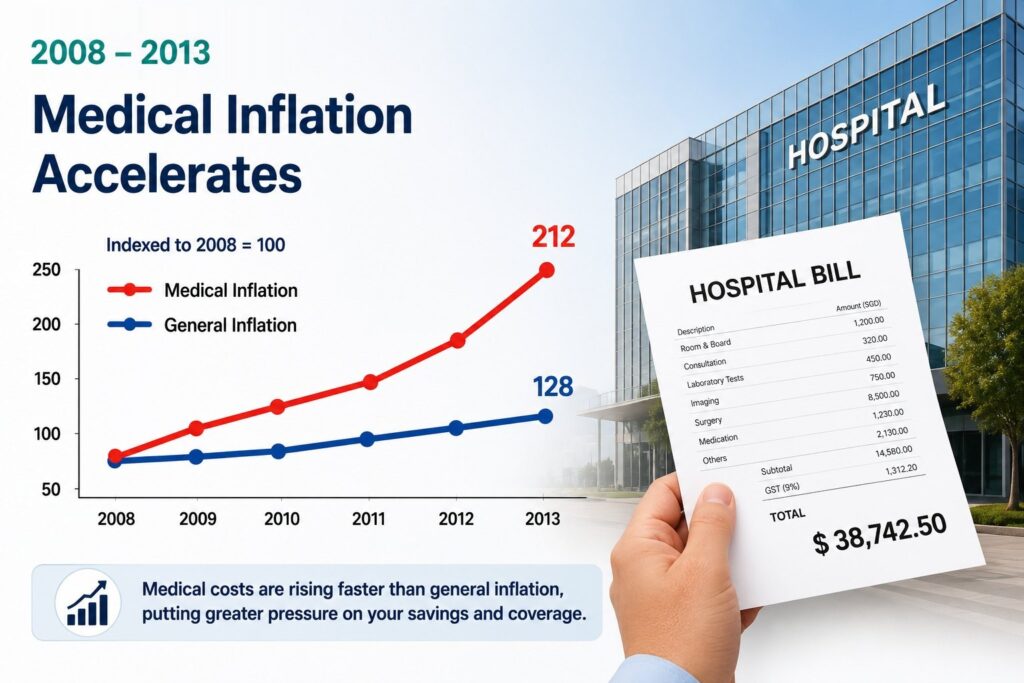
Medical inflation accelerated.
The data eventually proved him right. Between 2015 and 2020, claims incidence grew at a compound annual rate of about 15% for full riders on private hospital plans. For riders with some co-payment, that figure was close to zero. Average bill sizes on full-rider claims ran at least 20% higher.
2015 — MediShield Life. The national scheme became universal and lifelong, covering all Singaporeans and PRs including those with pre-existing conditions, who pay a 30% additional premium for the first ten years. The catastrophic layer was nationalised. The layers above it stayed private — and stayed exposed.
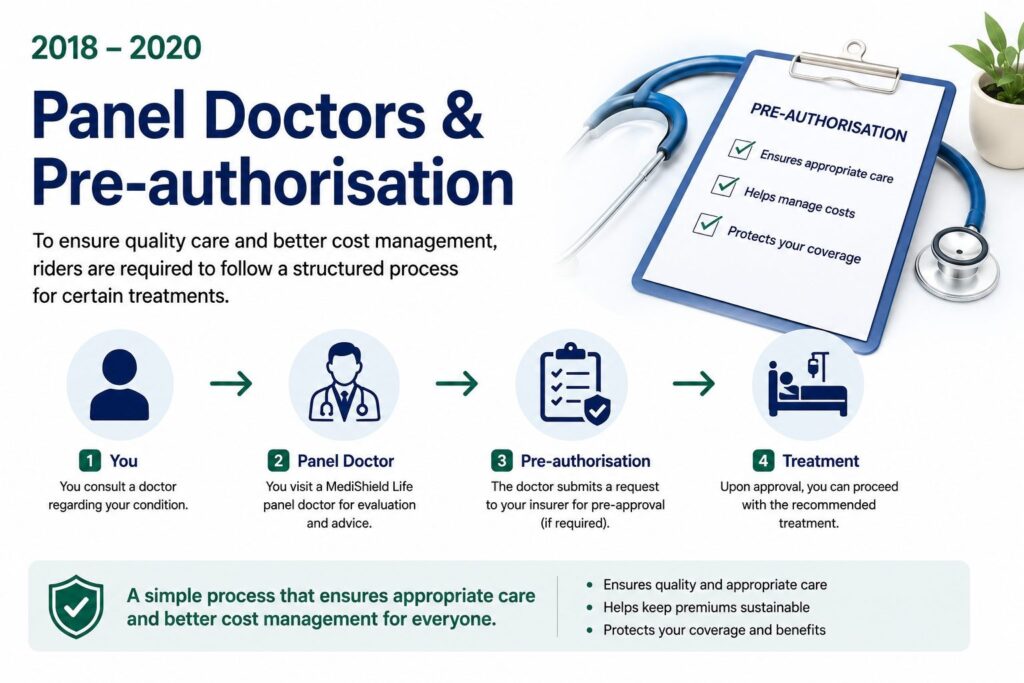
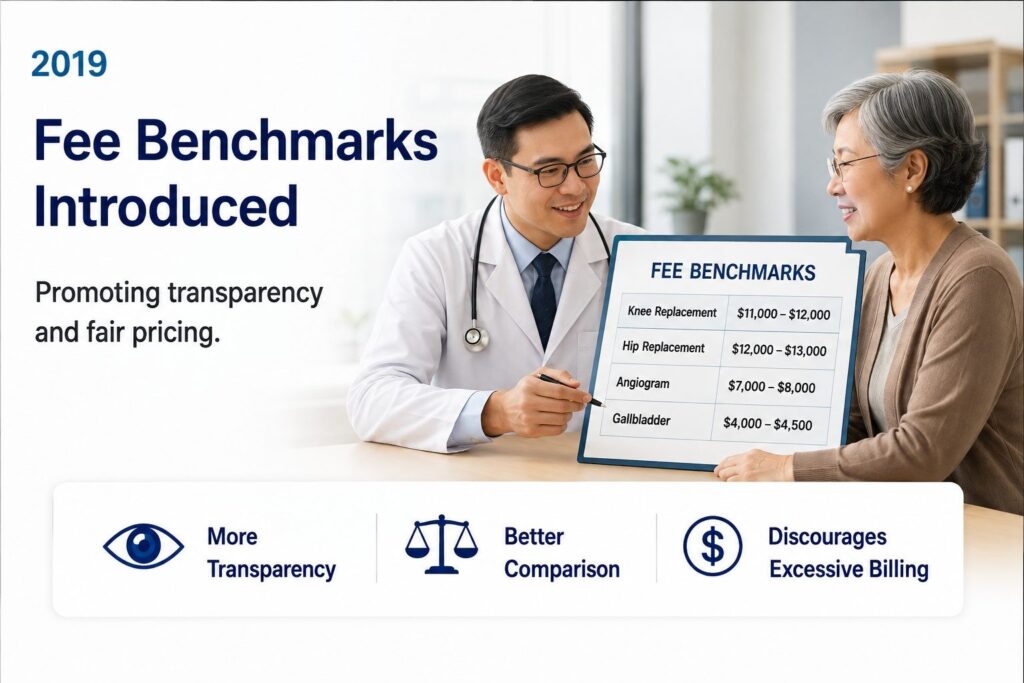
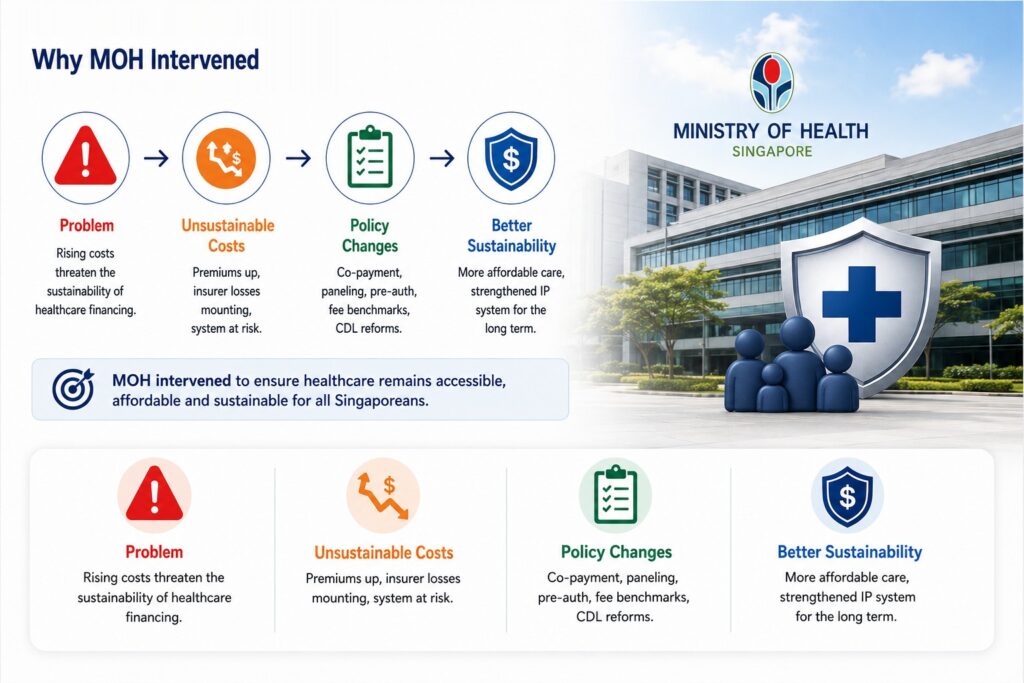
2016 — Health Insurance Task Force, which recommended fee benchmarks, panel networks, pre-authorisation and co-payment. This set the policy direction for everything after.
2018 — The first correction.
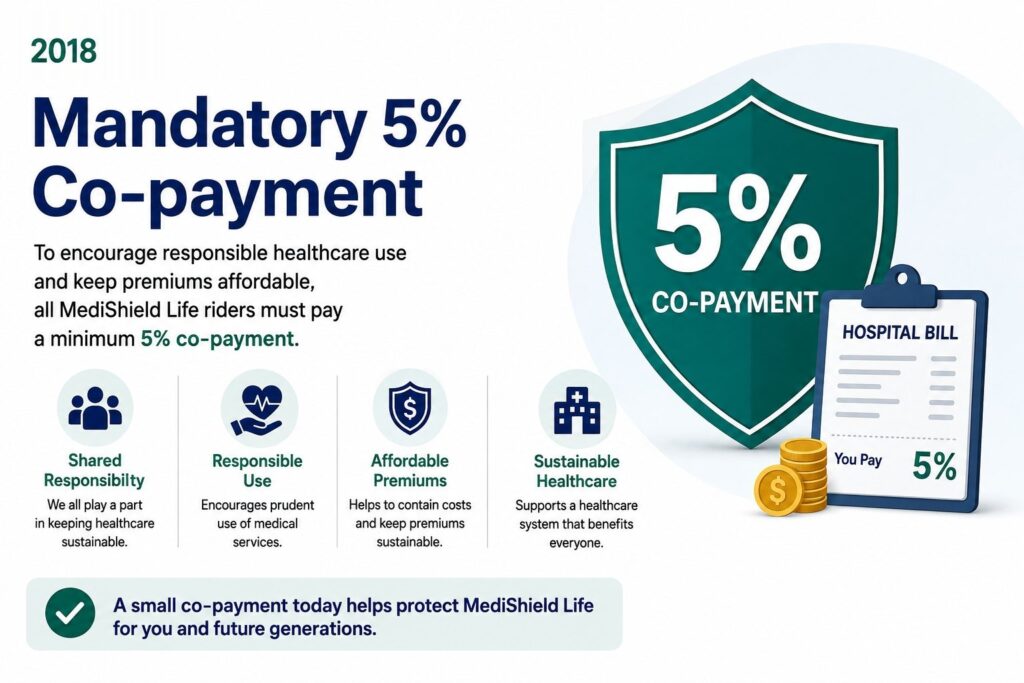
MOH mandated a minimum 5% co-payment on all new riders, capped at S$3,000 per policy year. Full riders stopped being sold. Existing ones were grandfathered, creating a closed block of the highest-utilising policyholders that insurers could no longer re-underwrite — only reprice. I wrote about how those earlier rounds of Shield plan changes played out when the Cancer Drug List was first announced.
The data justifying it: between 2015 and 2020, the compound annual growth rate of claims incidence was about 15% for full riders of private hospital IPs and about 9% for restructured hospital IP full riders, versus close to 0% for riders with some co-payment. Average bill size for full-rider claims was at least 20% higher.
2018 onwards — fee benchmarks, panels, claims-based pricing Insurers rolled out preferred panels, pre-authorisation, and claims-based pricing. Under claims-based pricing, rider premiums at renewal are adjusted based on claims in the previous policy year — with steeper loading for non-panel claims
COVID-19 and the New Reality of Medical Inflation
Between 2020 and 2022, two forces collided to push medical costs sharply higher: global inflation and a backlog of elective surgeries. When restrictions eased, hospitals faced a surge of postponed procedures at the same time supply costs, staffing, and equipment prices were climbing worldwide. The result was a jump in healthcare utilisation and claims that insurers — and ultimately policyholders — are still feeling today.
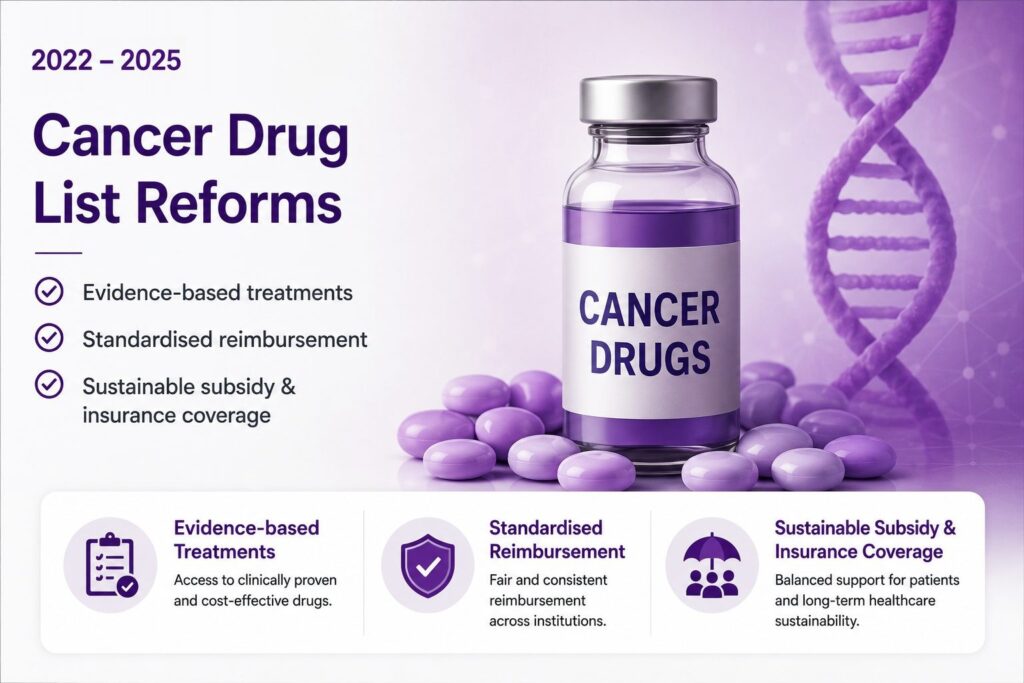
2021–2023 — The Cancer Drug List. From September 2022, MediShield Life and MediSave covered only cancer treatments on an approved list. From April 2023, the same applied to Integrated Shield Plans. Previously, most IPs had covered outpatient cancer drugs “as charged” against policy limits that could exceed S$2 million. That is a very large door that has now closed.
Insurers responded in the only way available to them. Cancer treatment and non-CDL drug coverage moved out of the base plan and into the riders — which quietly changed what a rider is for. It had been a convenience, absorbing your deductible and co-insurance. It became the only thing standing between you and the full cost of a treatment your oncologist recommends but the national list does not fund.
That made riders considerably more essential. It also made them considerably more expensive — and it concentrated the cost in the one component that must always be paid in cash. If the co-payment and panel rules still feel opaque, I have a plain-language walkthrough of how IP riders actually work.
April 2025 — MediShield Life enhanced. Annual claim limit raised from S$150,000 to S$200,000, with higher limits for daily charges, surgery and intensive care. Premiums rise by up to 35%, phased over three years to March 2028, averaging 22% per policyholder. The outpatient deductible arrives 1 June 2026, with the second phase of the inpatient deductible increase on 1 April 2027. The Government is putting S$4.1 billion behind cushioning it.
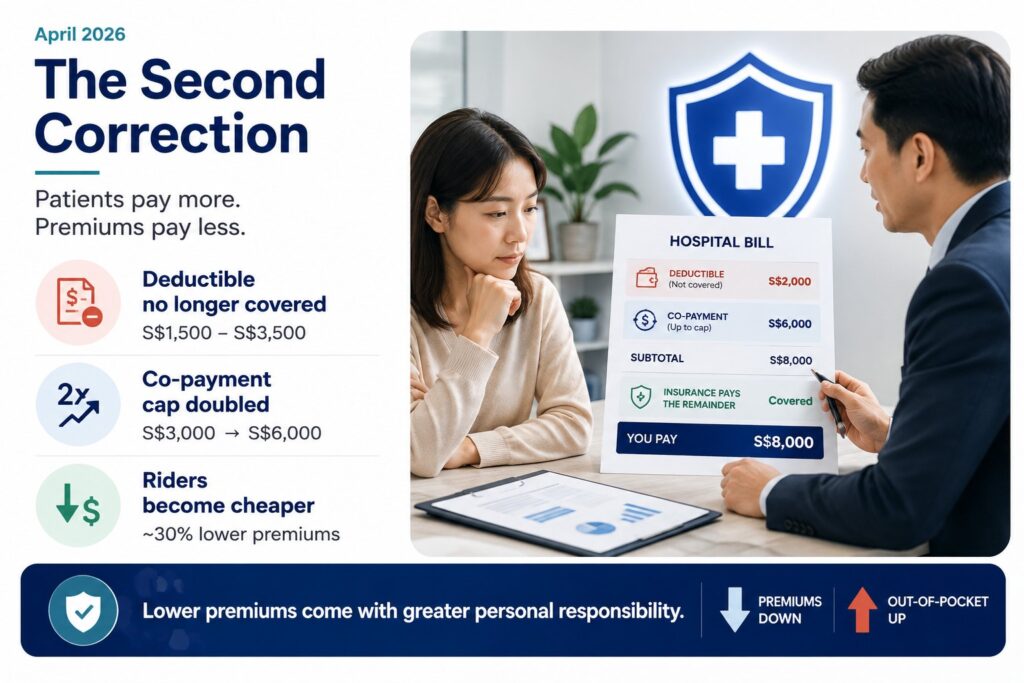
April 2026 — The second correction. New IP riders can no longer cover the minimum deductible, which ranges from S$1,500 to S$3,500 depending on ward class. The co-payment cap doubles from S$3,000 to S$6,000. New private hospital riders are roughly 30% cheaper as a result — because they cover roughly 30% less.
Why Premiums Continue to Rise
Several factors now work together.
Singapore has one of the fastest ageing populations in Asia.
New medical technology improves outcomes but is more expensive.
Cancer drugs and biologic therapies can cost tens of thousands of dollars.
Hospital operating costs continue to increase.
Doctors and specialists command higher professional fees.
Medical inflation has consistently exceeded general inflation.
To ensure long-term sustainability, MOH introduced several reforms, including mandatory co-payments for riders, specialist panels, fee benchmarks and tighter reimbursement rules for cancer treatments.
These measures help slow rising claims, but they cannot eliminate medical inflation.
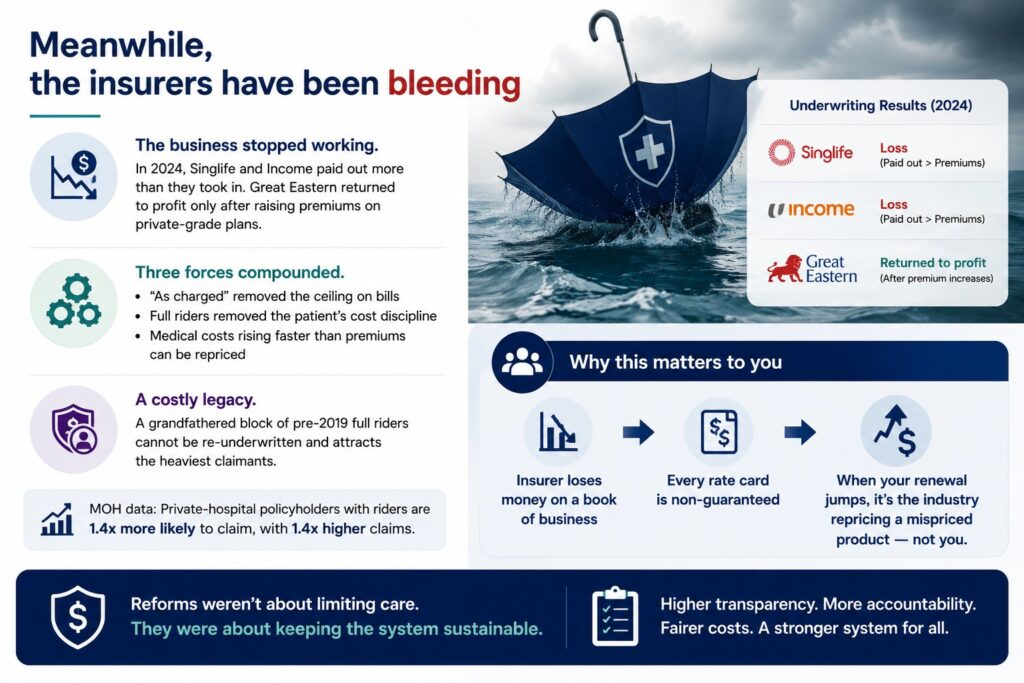
Meanwhile, the insurers have been bleeding
None of these reforms happened in a vacuum. They happened because the business stopped working.
Underwriting results filed with the Monetary Authority of Singapore show almost every Integrated Shield Plan insurer struggling in recent years. Singlife and Income both paid out significantly more than they took in during 2024. Great Eastern reversed its 2023 losses only by raising premiums on its private-grade plans.
Three forces compounded. “As charged” removed the ceiling on what a hospital bill could be. Full riders removed the patient’s reason to care what it was. And medical costs have been rising faster than premiums can be repriced. Layered on top is a grandfathered block of pre-2019 full riders that cannot be re-underwritten and attracts the heaviest claimants. MOH’s own figures show private-hospital policyholders with riders are 1.4 times as likely to claim, with average claim sizes 1.4 times higher.
Here is why that matters to you rather than to shareholders. An insurer losing money on a book of business has exactly one lever, and it is your premium. Every rate card is non-guaranteed. When you open that renewal notice and the number has jumped, you are not being singled out — you are seeing an industry repricing a product that was mispriced for fifteen years.
Part Two: The Escalation, In Numbers
Two different numbers get quoted in this conversation, and confusing them is where most planning goes wrong.
The consumer number. Singapore’s CPI-Healthcare rose 59.1% between 2005 and 2025 — a compound rate of about 2.35% a year, modestly ahead of headline inflation at 2.14%. That sounds manageable. It is also the number that lulls people into complacency.
The insurance number. Medical trend rates — what it actually costs to insure a population, factoring in utilisation, treatment intensity and new therapies — tell a different story. Aon forecast an 11.1% rise across Asia-Pacific for 2025. Mercer Marsh Benefits forecast 12.5% for Asia in 2026, the sixth consecutive year of double-digit trends. The Life Insurance Association Singapore has pointed to Singapore medical costs rising 16.9% in 2026.
The gap between 2.35% and 12% is not a rounding error. It is the difference between a retirement plan that holds and one that doesn’t.
Why the divergence? CPI measures the price of a consultation. Medical trend measures the cost of treating a person — and we are consuming more scans, more procedures, more biologics, and living longer with more chronic conditions while doing it. Your premium is priced off the second number, not the first.
There is a second escalator working alongside it: you also get older. Integrated Shield premiums step up sharply by age band, independently of inflation. A 45-year-old is not simply paying today’s premium plus inflation at 65 — they are paying the 65-year-old premium, inflated for twenty years of medical trend. Two multipliers, stacked.
What that looks like on a real rate card
Let me put actual numbers to it, because the abstraction does not land the way the arithmetic does.
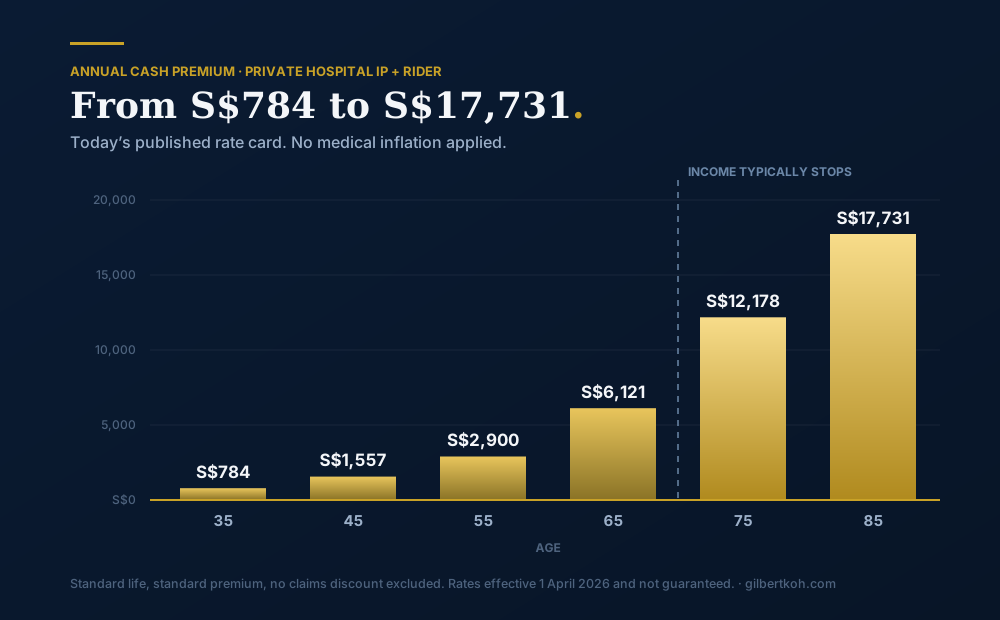
Take a 35-year-old on a private-hospital Integrated Shield Plan with a rider — the standard arrangement for a working professional in Singapore. The figures below are the cash portion of the annual premium, taken from a major insurer’s published 2026 rate card. Not projections. Not estimates. What the table says today.
That is a 22.6-fold increase — and not a single dollar of medical inflation has been applied to it.
This is the number that breaks retirement plans. Nobody budgets a line item that grows twenty-two-fold. People anchor on what they pay today, quietly assume it drifts up with general inflation, and build a retirement number on that assumption.
Two features of this table deserve attention.
First, the shape. The cost does not rise smoothly. It is flat-ish through your thirties and forties, steepens through your fifties and sixties, and accelerates hardest after seventy. Across the full span from 35 to 85, 64% of the total cash cost falls after age 71 — in the fifteen years when employment income has ended and MediSave contributions have stopped.
Second, the cash. MediSave carries the MediShield Life portion and part of the plan premium, but rider premiums must be paid in cash, always. On a private-hospital arrangement, MediSave covers only about a fifth of the lifetime bill. The remainder comes from your pocket, every year, for as long as you live.
Add the two escalators together and the totals are sobering. Summed across ages 35 to 85 at today’s rates, that private-hospital arrangement costs roughly S$331,000 in cash. Apply even a modest 4% annual repricing — well below the medical trend rates cited above, and insurers do reprice — and the lifetime cash figure approaches S$1.5 million.
Figures derived from a major Singapore insurer’s published premium rates effective 1 April 2026, for a standard life on a private-hospital plan with rider, excluding any no-claims discount. Premium rates are not guaranteed and may be revised by the insurer. Your own figures will differ by insurer, plan, ward class, health status and claims history.
Part Three: What Medical Costs in Retirement Do to Your Plan
Here is the uncomfortable arithmetic.
1. Your medical premium is a lifetime liability, not an annual expense.
Most people budget for their Shield plan the way they budget for a mobile plan — a monthly line item. But you will pay this premium every year for the rest of your life, and it will grow faster than your CPF LIFE payout, faster than your bond coupons, and faster than most people’s dividend income.
The table above makes the scale of it concrete. The S$12,178 a year at 75 is the figure worth sitting with — not because it is unaffordable, but because it has to come from somewhere, and in most plans I review, nothing has been set aside for it.
MediSave helps, but MediSave withdrawal limits are fixed dollar amounts that do not index — S$300, S$600 and S$900 a year depending on age — while the premium climbs. And MediSave contributions stop when you stop working. Rider premiums must be paid in cash, always. That is a cash obligation running into your eighties and nineties, at a growth rate you do not control.
2. Your out-of-pocket exposure has been deliberately increased.
From April 2026, a private-hospital policyholder on a new rider faces up to S$3,500 in deductible plus up to S$6,000 in co-payment. Around S$9,500 a year of exposure that no rider is legally permitted to absorb. This is by design — MOH is restoring the price signal.
That is manageable at 45 with an income. At 72, on a fixed drawdown, in a year with two admissions, it is a different conversation entirely.
3. The catastrophic layer is covered. The chronic decades are not.
MediShield Life protects you against the S$200,000 event. Retirement healthcare is rarely one large event. It is fifteen years of specialist reviews, medications, scans, day surgeries, physiotherapy, and eventually help with daily living — the accumulation, not the catastrophe. Almost none of that is what a hospital plan was designed for.
4. Non-CDL cancer treatment is now a cash problem.
The Cancer Drug List has done its job in controlling costs. But if the treatment your oncologist recommends sits outside the list, the funding gap falls to your rider, a critical illness policy, or your savings. For a retiree, “your savings” means selling assets at whatever price the market offers that quarter.
Part Four: What a Sound Plan Actually Looks Like
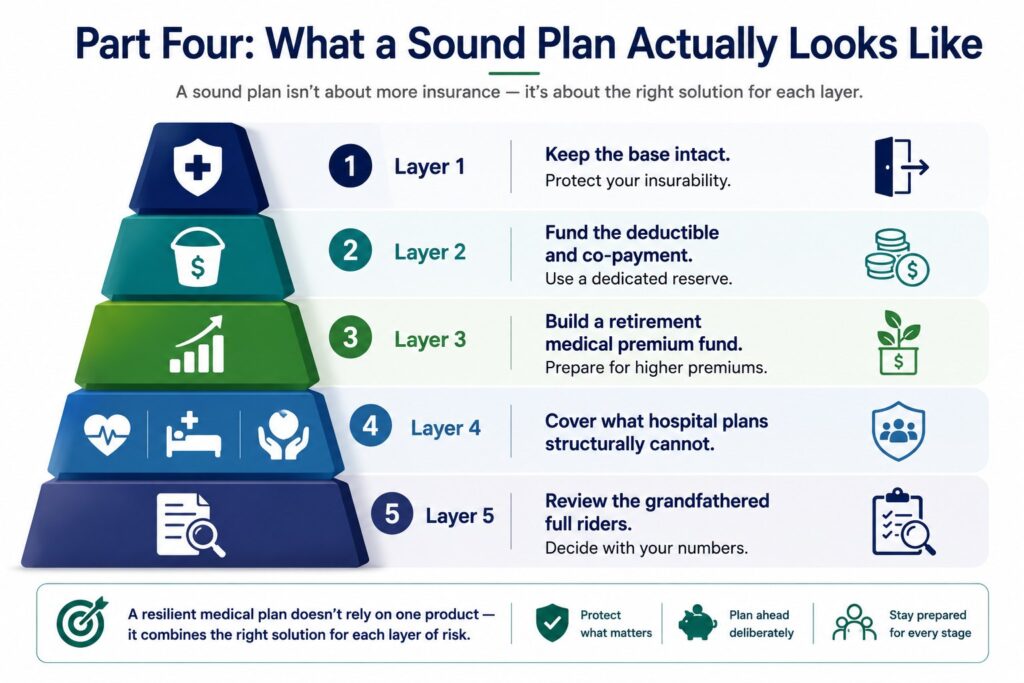
I do not think the answer is to buy more insurance. I think the answer is to plan for medical costs the way we plan for any other long-duration, inflating liability — deliberately, with the right instrument for each layer.
Layer 1 — Keep the base intact. Never let a Shield plan lapse to save premium. Underwriting is a one-way door; you can always downgrade the ward class or drop to a public-hospital plan, but you cannot buy back health you have since lost. More on this on my health insurance planning page.
Layer 2 — Fund the deductible and co-payment deliberately. Ring-fence a dedicated medical reserve, sized to cover several years of the S$9,500 maximum exposure, held in cash or near-cash. Not “I’ll take it from the portfolio.” Take it from a bucket that exists for exactly this.
Layer 3 — Build a retirement medical premium fund. This is the piece almost nobody does. If your Shield and rider premiums at 70 will be several times today’s figure, that liability deserves its own asset, accumulated during your earning years. An endowment, an annuity stream, or a dedicated portfolio sleeve — the vehicle matters less than the earmarking. This sits inside the wider question of retirement planning, and the earlier you start, the less it costs — as I set out in the cost of waiting.
Layer 4 — Cover what hospital plans structurally cannot. Critical illness for income replacement and non-CDL treatment. Hospital cash for the days themselves. Long-term care — CareShield Life plus supplements — for the years when the problem is not a hospital at all. I have covered CareShield Life and supplements separately.
Layer 5 — Review the grandfathered full riders. If you have held a pre-2019 full rider, you are in the block insurers most want to reprice. Whether to stay or switch depends on your age, your health, and whether you would survive fresh underwriting. That is not a decision to make from a marketing email. It is a decision to make with your numbers in front of you.
The Point
Singapore’s healthcare financing system is one of the best-designed in the world. Every reform since 2018 has moved in one consistent direction: the state guarantees you against catastrophe, and asks you to own the first dollars of your care.
That is sound policy. It is also a transfer of risk — to you, over a retirement that may run thirty years, against a cost curve compounding at double digits.
The plan you built five years ago probably did not price that in. Most didn’t.
Gilbert Koh is an Independent Financial Adviser and MDRT Life Member based in Singapore, representing Avallis Financial. He holds a BBA (Finance) from the National University of Singapore and specialises in protection, wealth accumulation, education and retirement planning for career-progressive Singaporeans and PRs.
Reach him at gilbert@avallis.com
Sources: Ministry of Health Singapore; CPF Board; Singapore Department of Statistics; Aon 2025 Global Medical Trend Rates Report; Mercer Marsh Benefits 2026 Health Trends; Life Insurance Association Singapore. Figures accurate as at July 2026. This article is for general information and does not constitute financial advice. Please seek advice tailored to your circumstances before making any decision.
Ask anyone who started investing early in Singapore and they’ll tell you the same thing: the amount mattered less than the head start.
The one asset you can never buy back
Why time is your most powerful financial tool — and what procrastination truly costs you
You can earn more money. You can find a better job, cut spending, and rebuild savings after a setback. But there is one resource that, once spent, cannot be recovered: time. In financial planning, time is not merely a backdrop — it is the engine. And those who start early pay far less for far more.
This article explores two areas where time works either powerfully for you, or silently against you — insurance planning and wealth accumulation. In both, the cost of waiting is not abstract. It is measured in dollars, doors closed, and dreams deferred.
Part 1 — Insurance: the price of good health
Most people think about insurance when something goes wrong. A diagnosis. An accident. A friend who was suddenly uninsurable. By then, the window has often closed.
Insurance is unique among financial products: it prices not what you have, but what you are. Right now, if you are healthy, you are holding something immensely valuable — the ability to qualify for coverage at the most favourable rates, with no exclusions, no clauses, no asterisks in the fine print. That value depreciates every year, and it can disappear overnight.
“The best time to buy insurance is when you don’t need it. By the time you do, you may not qualify.”
What age does to premiums
Insurers price risk. As you age, your statistical likelihood of making a claim rises — and your premiums reflect this precisely. Consider a 30-year-old purchasing a whole life policy versus waiting until 40 or 45:
Age at application
Illustrative monthly premium
vs Age 30
Age 30
$180 / month
—
Age 35
$270 / month
+50%
Age 40
$365 / month
+103%
Age 45
$495 / month
+175%
Figures are illustrative only. Actual premiums vary by insurer, product type, sum assured, and individual health status.
Waiting just 15 years — from age 30 to 45 — can more than double, sometimes nearly triple, your monthly premium for the same coverage. Over a 20-year policy, that difference compounds to tens of thousands of dollars paid extra, simply for having delayed.
The risk beyond premiums: exclusions and declined applications
Higher premiums are uncomfortable. But they are not the worst outcome. The more serious consequence of delay is what happens to your eligibility as your health changes.
A common health event — high blood pressure, elevated cholesterol, a minor cardiac episode, diabetes, a mental health diagnosis — can result in:
Exclusion clauses — coverage is issued, but the insurer excludes the affected condition entirely. You may be insured against everything except the thing most likely to affect you.
Premium loading — your rate is significantly increased above the standard rate due to elevated risk, and may remain so permanently.
Application declined — for serious pre-existing conditions, cover may simply be refused, leaving you with no protection at all.
None of these outcomes are hypothetical. They happen every day to people who assumed they would “get around to it.” The tragedy is that in most cases, they were perfectly insurable just a year or two before — they simply did not act.
“A pre-existing condition is not just a health problem. It is a financial problem that can follow you for the rest of your life.”
The message is not to create fear — it is to create urgency. If you are healthy today, today is the cheapest and most open door you will ever have. Act while it is still wide open.
Part 2 — Wealth accumulation: the compounding clock
Compound interest has been called the eighth wonder of the world — and the mathematics truly is remarkable. But the engine that drives it is not the interest rate. It is time. Specifically, the length of the compounding period. Cut that period short, and you do not just earn less — you must work dramatically harder to compensate.
Illustration: saving for a child’s university education
Imagine the day your child walks across that graduation stage, diploma in hand, surrounded by proud family — that moment 18 years in the making, made possible by a plan you started at birth.
Suppose your goal is $200,000 for your child’s tertiary education by the time they turn 18. Assuming a 6% annual return, compounded monthly:
Start at birth (18 years)
Start at age 6 (12 years)
Monthly contribution needed
$516
$952
Total amount invested
$111,526
$137,045
Growth from investment returns
$88,474
$62,955
Goal achieved?
Yes ✓
Significantly harder
Assumes $200,000 target, 6% p.a. compounded monthly, contributions made at end of each month.
Waiting just six years means you need to save 84% more per month — and invest $25,000 more in total — for the exact same outcome. The returns work less hard because time robbed them of their runway. Many families find that level of monthly commitment unworkable, and the goal becomes compromised or abandoned entirely.evel of monthly commitment unworkable, and the goal becomes compromised or abandoned entirely.
Illustration: Retirement planning at 6% IRR
Picture a couple sitting by the sea, unhurried, watching the horizon together — the retirement they planned for, decade by decade, one consistent decision at a time. That vision is within reach. But the path to it narrows quickly with every year of delay.
Consider individuals all targeting $1,000,000 at age 65, investing at 6% per annum, compounded monthly:
Age you start
Years to invest
Monthly savings needed
Total invested
Growth from returns
Age 25
40 years
$502
$241,025
$758,975
Age 30
35 years
$702
$294,797
$705,203
Age 35
30 years
$996
$358,382
$641,618
Age 40
25 years
$1,443
$432,904
$567,096
Age 45
20 years
$2,164
$519,435
$480,565
Assumes $1,000,000 target at age 65, 6% p.a. compounded monthly, contributions made at end of each month.
The person who starts at 25 needs $502 a month. The person who waits until 45 needs $2,164 — more than 4 times as much — for the exact same result. Notice also what happens to the “Growth from returns” column: the early starter lets compounding do most of the heavy lifting ($759K of growth on just $241K invested), while the late starter must personally fund over half the target through their own contributions. And critically, those starting at 45 must find that money during life’s most financially demanding years: mortgages, children’s school fees, ageing parents, career transitions. as much — for the exact same result. And critically, those starting at 45 must find that money during life’s most financially demanding years: mortgages, children’s school fees, ageing parents, career transitions.
“Starting early doesn’t just build wealth. It removes financial stress from the years you can least afford it.”
The compounding timeline — where you stand today
Age
Compounding window
Status
25
40 years
Prime window — act now
30
35 years
Still strong — don’t delay further
35
30 years
Cost rising — every month matters
40
25 years
Significant gap — needs higher commitment
45
20 years
Steep climb — still possible, but demanding
50+
<15 years
Very difficult — urgent action required
Wherever you are on this timeline — the right answer is identical: start now. Not tomorrow. Not after the next pay rise. The second-best time to plant a tree was yesterday. The best time is today.
The cost of “I’ll do it later”
Procrastination is the single most expensive financial decision most people make. It is invisible, painless in the moment, and its consequences reveal themselves slowly — until they arrive all at once.
Consider the full picture of what delay costs across both areas:
In insurance — waiting means higher premiums, possible exclusions of the very conditions that matter most, or being declined entirely. The healthy self you have today is an asset with a ticking expiry.
In wealth accumulation — waiting means needing to save far more each month for the same outcome, putting enormous pressure on your future income and lifestyle. Your money has less time to work, so you must work harder instead.
Both problems compound. And both are entirely preventable — simply by deciding to act today.
Where to begin
You do not need to solve everything at once. You need to start. Here is a simple four-step framework:
Step 1 — Protect what you have, while you still can
Review your insurance needs while your health is on your side. If you do not have life, critical illness, or disability coverage — or if you have not reviewed existing policies in years — make that your first call this week. Tomorrow is not guaranteed; your eligibility today is.
Step 2 — Set a compounding goal and work backwards
Identify one wealth goal — your child’s education, your own retirement, financial independence — and calculate what a monthly commitment looks like if you start today. The number is always more manageable now than it will be in five years. Start, even imperfectly.
Step 3 — Automate contributions and let time do the work
The people who build wealth reliably are not the cleverest investors — they are the most consistent ones. Set up automatic monthly contributions so saving happens before spending. Discipline becomes effortless when it is built into the system.
Step 4 — Review annually and adjust as life evolves
Life changes — income grows, families expand, goals shift. Your coverage and contributions should change with it. A yearly review with a trusted adviser keeps your plan current and ensures you are never under-protected or under-invested. Small adjustments early prevent large shortfalls later.
Your future self is counting on you. Every day you wait, the cost rises. Every day you act, time works harder for you. The gap between the two is compounding right now — in one direction or the other.
Disclaimer: Figures used in this article are illustrative only and do not constitute financial advice. Actual premiums and investment returns will vary based on individual circumstances, health status, product type, and market conditions. Please consult a licensed financial adviser for personalised recommendations.
Insurance industry changes in Singapore don’t happen often, but when they do, policyholders are usually the last to find out.
In the course of the past few weeks, I have received inquiries on new and pending changes to the insurance industry and so I would like to share this news and how it’ll affect you as a policyholder.
1. Updated Critical Illness (CI) definitions come Aug 2020
This is done to “address ambiguities that have arisen due to medical advancements and health trends in the past five years,” said Mr. Khor Hock Seng, president of LIA Singapore and allow standardization of CI definitions across all insurers.
Existing individual life policies are unaffected but group insurances are expected to be I believe.
If you wish to benefit under the current set of definitions, do get in touch with me asap.
If you are holding on to a policy purchased at least 2-3yrs ago, it’ll probably cover just 30 CI. Now, it’s pretty common for insurers to provide 35 CI and there are a few offering up to 55 CI.
More comprehensive coverage is of course better for you.
This was introduced sometime back in 2015 and the product terms and premium have now reached a certain level of stability and maturity.
Given that people are now more concerned over their state of health and will attend more regular health screenings, it, therefore, allows early detection of health issues and necessary treatment.
Allowing an early claim on health conditions will provide you greater peace of mind over healthcare bills and the option to say, take sabbaticals or take a step down from work to focus on the recovery of your health or spend more time with your loved ones.
Using Cancer as an example, you will note that Carsinoma-in-situ is excluded under the Advanced stage cancer definition whereas you will note that it is a covered or claimable event under Early stage cancer.
This then leads to the question on whether you prefer an early claim or when the illness has deteriorated till a possibly irreversible point? I believe the answer is obvious.
As Early CI coverage significantly increases the probability of a claim, the premium will be higher compare to an Advanced stage only CI cover, but well worth it’s value if you can budget for it.
In a nutshell, this will be a new capital framework by MAS for insurers to enhance risk assessment so that capital requirements are more aligned to it’s business and risk profiles.
While the new regulatory requirements will serve to improve the solvency of the insurer and ensure that the guarantees in their policy contracts will be better backed by appropriate assets e.g long term government bonds, the prevailing low bonds yields will mean a higher than desired proportion of the par fund will have to be allocated to bonds.
Resulting from above, a lower allocation to equities in the par fund may impact the insurer’s ability to meet investment returns originally projected. Worst case, you can expect to experience cuts in reversionary bonus and/or terminal bonuses on existing issued policies.
For upcoming policies, you can expect a lowering of the investment projection to max 4.5%p.a (was at 5.25%p.a when I first joined the career back in 2003), lower guarantees and restructuring of bonuses away from reversionary bonus towards terminal bonus. This, in turn, creates greater uncertainty for the policyholder to evaluate the non-guaranteed projections by the insurer.
Will this mean that endowments will no longer be attractive?
– This is a new normal and your bank deposits are not immune.
If you wish to secure the accumulation savings plans under the current guarantees and bonus structure, do get in touch with me asap.
Lastly, don’t let short term disruptions like Covid-19 put a pause on achieving your long term financial goals. With courage and determination, your continued action today will serve you well in future.
Your ideal retirement lifestyle in Singapore probably looks different from the default picture most people imagine — which is exactly why it’s worth defining early.
What comes to your mind when you think about your retirement?
Option A Staying at home looking after your grandchildren, taking public transport to meet friends over coffee or majong. Taking an occasional vacation to a nearby destination in Asia. Healthcare options are limited to government restructured hospitals. Financially independent.
Option B Zipping around town in your car meeting friends for a round of golf followed with a high tea buffet in a hotel and some shopping in town. Have the option to change your car every 5-7yrs. Ability to afford at least 2 vacations globally a year with your grandchildren. Healthcare options are available up to private specialists and hospitals. Financially independent with a decent-sized estate that can be passed down to your children and grandchildren.
Whether it’s option A or B will depend very much on your desired retirement lifestyle and the size of your retirement nest egg prevailing at that point. The more funds you have, the more retirement options will be available to you.
For most working professionals, I believe they will desire a lifestyle similar to option B but interestingly, their retirement plans may not match that objective. Why?
Some of the possible reasons are as follows:-
Prioritizes immediate gratification over deferred enjoyment
Low savings ability due to inability to curb lifestyle spending &/or over-commitment to car and housing. With our high property prices, it is not uncommon to see couples saddled with at least S$1mil in housing loan nowadays
Having a single income to support the family after a spouse leaves employment to look after the children
Being overweight in investments with a performance that did not pan out as expected. Wost still, ended with a capital loss.
Procrastination leading to delay and underfunding in the accumulation plan
Overestimated that CPF alone will be sufficient for retirement
Underestimation of how much is required at retirement age to live that desired retirement lifestyle
In this article, I’d like to discuss point #7.
To facilitate the discussion, let’s think of retirement to like taking a long term overseas vacation…something that most of you will be able to identify with. After all, taking overseas vacations is one of the most favorite pastimes for overworked Singaporeans, wouldn’t you agree?
A. The Destination
With every vacation, it starts with the destination.
Given our longevity, retirement may span at least 25yrs. Hence, for discussion purpose, let’s assume that we’re taking a Flight to Brazil which is a 30 hour flight time
Perception pitfall: one may think that the retirement period is far shorter ST article
B. Plane type, Engine, and thrust, fuel capacity
Given the destination, which plane do you think can best bring you there most effectively in one piece with minimal refueling stops? A turboprop, piston, midsize jet or a wide-body airliner? – A wide-body airliner of course!
In financial planning terms, the size of the plane is akin to the size of the retirement nest egg required to provide you with the desired retirement lifestyle. If your financial adviser has done a calculation for you, you will realize that it’s no small change. After all, Singapore is reputed to be one of the most expensive cities to live in.
With a large airplane, it needs to be equipped with large engines and fuselage to power the aircraft. Moreover, the cost of the plane is not constant. Instead, it goes up over time due to inflation.
Hence in financial terms, the earlier we start accumulating and the higher the regular contribution, the more power you will inject into the accumulation process…and the more likely we can achieve our retirement goal.
Moreover Perception pitfall: one may think that they can rely on CPF alone or that retirement doesn’t require too much money. ST article
C. The Runway
Every plane needs a runway to allow it to pick up speed for take-off. Similarly for retirement, the runway is the time period from now till our expected retirement age. This is the critical period for us to contribute towards our retirement nest egg, and take advantage of the compounding effect of money.
Typically the larger the plane, the longer the runway needed. Since we have deduced from above that we’ll require a Airbus A380 equivalent, we do need a long runway for it to do a proper take-off, agree? That means that we really need to start early – as soon as we’re in our age 30s, to start the accumulation process. Appreciating this point is the most important part of the accumulation process.
If we take advantage of the long runway by starting early, small regular contributions can allow us to achieve our retirement goal with little financial stress. We can see that through the effect of compound interest in the picture below. It certainly looks like a plane take off trajectory, isn’t it?
However, if we procrastinate and start later in life e.g age 45, the runway will be shorter and we will be required to contribute significantly more on a monthly basis to reach the same end goal. That would be pretty stressful, wouldn’t it? Another example can be seen in the following
If you’re only starting to accumulate in your 50s, your runway will be rather short and you will need all the financial firepower you can give to your accumulation plan. If you fail to do that, I’m afraid you may have to consider deferring your retirement age and/or downgrade your retirement expectation.
In summary, our ability to achieve our retirement goals are dependant on how well we manage the following 4 parameters:-
1. desired Retirement Lifestyle, expected Longevity and Inflation – which will determine how much is needed at retirement age 2. Accumulation Period 3. Size of the Regular Contribution to the plan 4. Rate of Return on the plan (which I’ll address in a later article)
Ready to take off to retirement bliss? Get in touch with me at gilbert@avallis.com
Securing your retirement requires one to follow certain systematic steps, cultivate good financial habits and applying action plans to achieve it. It certainly does not happen by chance.
To secure your comfortable retirement, just send me an email on the right and we’ll get in touch soon.
Till then… Live life to the Fullest, without Regrets!
“MEN in Singapore have the second highest healthy life expectancy in the world and women the fourth highest…..But these longer healthy lives also come with longer years of disability”
“A boy born here in 2010 can expect to live 68.1 years in good health and 10.7 years coping with serious disability.
“A girl can expect 70 years of healthy life and 13.3 years with poor health”
“Women are hit especially hard by disability. Women aged 15 to 65 years lose more healthy life to disability than men.”
Should health fails and your income ceases, how much are you willing to drain your reserves to fund your healthcare cost? how will you continue to care for your family and fund your financial commitments?
Do you have disability insurance? Do you realize that many disability situations will not satisfy a Death, TPD or Critical Illness claim? i.e none of your existing policies will offer a payout. Hence, not having one is akin to trying to shield you and your family with an umbrella with gaping holes or caring for them in a house with a leaking roof.
Would you do that to your family?
To seek advise on the above, just send me an email on the right and we’ll get in touch soon.