
Ask anyone who started investing early in Singapore and they’ll tell you the same thing: the amount mattered less than the head start.

The one asset you can never buy back
Why time is your most powerful financial tool — and what procrastination truly costs you
You can earn more money. You can find a better job, cut spending, and rebuild savings after a setback. But there is one resource that, once spent, cannot be recovered: time. In financial planning, time is not merely a backdrop — it is the engine. And those who start early pay far less for far more.
This article explores two areas where time works either powerfully for you, or silently against you — insurance planning and wealth accumulation. In both, the cost of waiting is not abstract. It is measured in dollars, doors closed, and dreams deferred.
Part 1 — Insurance: the price of good health

Most people think about insurance when something goes wrong. A diagnosis. An accident. A friend who was suddenly uninsurable. By then, the window has often closed.
Insurance is unique among financial products: it prices not what you have, but what you are. Right now, if you are healthy, you are holding something immensely valuable — the ability to qualify for coverage at the most favourable rates, with no exclusions, no clauses, no asterisks in the fine print. That value depreciates every year, and it can disappear overnight.
“The best time to buy insurance is when you don’t need it. By the time you do, you may not qualify.”
What age does to premiums
Insurers price risk. As you age, your statistical likelihood of making a claim rises — and your premiums reflect this precisely. Consider a 30-year-old purchasing a whole life policy versus waiting until 40 or 45:
| Age at application | Illustrative monthly premium | vs Age 30 |
|---|---|---|
| Age 30 | $180 / month | — |
| Age 35 | $270 / month | +50% |
| Age 40 | $365 / month | +103% |
| Age 45 | $495 / month | +175% |
Figures are illustrative only. Actual premiums vary by insurer, product type, sum assured, and individual health status.
Waiting just 15 years — from age 30 to 45 — can more than double, sometimes nearly triple, your monthly premium for the same coverage. Over a 20-year policy, that difference compounds to tens of thousands of dollars paid extra, simply for having delayed.
The risk beyond premiums: exclusions and declined applications
Higher premiums are uncomfortable. But they are not the worst outcome. The more serious consequence of delay is what happens to your eligibility as your health changes.
A common health event — high blood pressure, elevated cholesterol, a minor cardiac episode, diabetes, a mental health diagnosis — can result in:
- Exclusion clauses — coverage is issued, but the insurer excludes the affected condition entirely. You may be insured against everything except the thing most likely to affect you.
- Premium loading — your rate is significantly increased above the standard rate due to elevated risk, and may remain so permanently.
- Application declined — for serious pre-existing conditions, cover may simply be refused, leaving you with no protection at all.
None of these outcomes are hypothetical. They happen every day to people who assumed they would “get around to it.” The tragedy is that in most cases, they were perfectly insurable just a year or two before — they simply did not act.
“A pre-existing condition is not just a health problem. It is a financial problem that can follow you for the rest of your life.”
The message is not to create fear — it is to create urgency. If you are healthy today, today is the cheapest and most open door you will ever have. Act while it is still wide open.
Part 2 — Wealth accumulation: the compounding clock
Compound interest has been called the eighth wonder of the world — and the mathematics truly is remarkable. But the engine that drives it is not the interest rate. It is time. Specifically, the length of the compounding period. Cut that period short, and you do not just earn less — you must work dramatically harder to compensate.
Illustration: saving for a child’s university education

Imagine the day your child walks across that graduation stage, diploma in hand, surrounded by proud family — that moment 18 years in the making, made possible by a plan you started at birth.
Suppose your goal is $200,000 for your child’s tertiary education by the time they turn 18. Assuming a 6% annual return, compounded monthly:
| Start at birth (18 years) | Start at age 6 (12 years) | |
|---|---|---|
| Monthly contribution needed | $516 | $952 |
| Total amount invested | $111,526 | $137,045 |
| Growth from investment returns | $88,474 | $62,955 |
| Goal achieved? | Yes ✓ | Significantly harder |
Assumes $200,000 target, 6% p.a. compounded monthly, contributions made at end of each month.
Waiting just six years means you need to save 84% more per month — and invest $25,000 more in total — for the exact same outcome. The returns work less hard because time robbed them of their runway. Many families find that level of monthly commitment unworkable, and the goal becomes compromised or abandoned entirely.evel of monthly commitment unworkable, and the goal becomes compromised or abandoned entirely.
Illustration: Retirement planning at 6% IRR

Picture a couple sitting by the sea, unhurried, watching the horizon together — the retirement they planned for, decade by decade, one consistent decision at a time. That vision is within reach. But the path to it narrows quickly with every year of delay.
Consider individuals all targeting $1,000,000 at age 65, investing at 6% per annum, compounded monthly:
| Age you start | Years to invest | Monthly savings needed | Total invested | Growth from returns |
|---|---|---|---|---|
| Age 25 | 40 years | $502 | $241,025 | $758,975 |
| Age 30 | 35 years | $702 | $294,797 | $705,203 |
| Age 35 | 30 years | $996 | $358,382 | $641,618 |
| Age 40 | 25 years | $1,443 | $432,904 | $567,096 |
| Age 45 | 20 years | $2,164 | $519,435 | $480,565 |
Assumes $1,000,000 target at age 65, 6% p.a. compounded monthly, contributions made at end of each month.
The person who starts at 25 needs $502 a month. The person who waits until 45 needs $2,164 — more than 4 times as much — for the exact same result. Notice also what happens to the “Growth from returns” column: the early starter lets compounding do most of the heavy lifting ($759K of growth on just $241K invested), while the late starter must personally fund over half the target through their own contributions. And critically, those starting at 45 must find that money during life’s most financially demanding years: mortgages, children’s school fees, ageing parents, career transitions. as much — for the exact same result. And critically, those starting at 45 must find that money during life’s most financially demanding years: mortgages, children’s school fees, ageing parents, career transitions.
“Starting early doesn’t just build wealth. It removes financial stress from the years you can least afford it.”
The compounding timeline — where you stand today
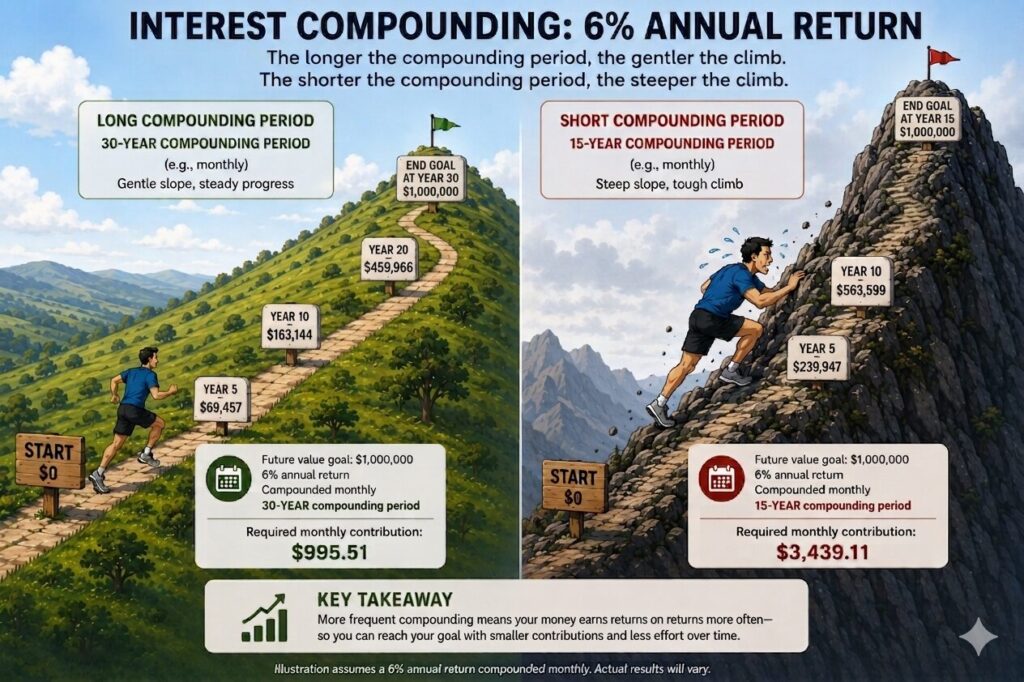
| Age | Compounding window | Status |
|---|---|---|
| 25 | 40 years | Prime window — act now |
| 30 | 35 years | Still strong — don’t delay further |
| 35 | 30 years | Cost rising — every month matters |
| 40 | 25 years | Significant gap — needs higher commitment |
| 45 | 20 years | Steep climb — still possible, but demanding |
| 50+ | <15 years | Very difficult — urgent action required |
Wherever you are on this timeline — the right answer is identical: start now. Not tomorrow. Not after the next pay rise. The second-best time to plant a tree was yesterday. The best time is today.
The cost of “I’ll do it later”
Procrastination is the single most expensive financial decision most people make. It is invisible, painless in the moment, and its consequences reveal themselves slowly — until they arrive all at once.
Consider the full picture of what delay costs across both areas:
- In insurance — waiting means higher premiums, possible exclusions of the very conditions that matter most, or being declined entirely. The healthy self you have today is an asset with a ticking expiry.
- In wealth accumulation — waiting means needing to save far more each month for the same outcome, putting enormous pressure on your future income and lifestyle. Your money has less time to work, so you must work harder instead.
Both problems compound. And both are entirely preventable — simply by deciding to act today.
Where to begin

You do not need to solve everything at once. You need to start. Here is a simple four-step framework:
Step 1 — Protect what you have, while you still can
Review your insurance needs while your health is on your side. If you do not have life, critical illness, or disability coverage — or if you have not reviewed existing policies in years — make that your first call this week. Tomorrow is not guaranteed; your eligibility today is.
Step 2 — Set a compounding goal and work backwards
Identify one wealth goal — your child’s education, your own retirement, financial independence — and calculate what a monthly commitment looks like if you start today. The number is always more manageable now than it will be in five years. Start, even imperfectly.
Step 3 — Automate contributions and let time do the work
The people who build wealth reliably are not the cleverest investors — they are the most consistent ones. Set up automatic monthly contributions so saving happens before spending. Discipline becomes effortless when it is built into the system.
Step 4 — Review annually and adjust as life evolves
Life changes — income grows, families expand, goals shift. Your coverage and contributions should change with it. A yearly review with a trusted adviser keeps your plan current and ensures you are never under-protected or under-invested. Small adjustments early prevent large shortfalls later.
Your future self is counting on you. Every day you wait, the cost rises. Every day you act, time works harder for you. The gap between the two is compounding right now — in one direction or the other.
Disclaimer: Figures used in this article are illustrative only and do not constitute financial advice. Actual premiums and investment returns will vary based on individual circumstances, health status, product type, and market conditions. Please consult a licensed financial adviser for personalised recommendations.
Time works against you on medical costs too, and rather more brutally. See why medical costs reshape a retirement plan.
