If you’re looking up how MyHealthPlus prior authorisation works, you probably have a hospital admission, day surgery, or a dialysis session coming up — and you don’t want a surprise bill. Here’s how MyHealthPlus prior authorisation actually works, in practical terms.
What MyHealthPlus actually is
MyHealthPlus is the rider that sits on top of a MyShield Integrated Shield Plan, covering the deductible and co-insurance your main plan leaves you to pay. It was originally an Aviva product. Aviva Singapore and Singlife merged in 2023, so if you hold MyShield or MyHealthPlus, your policy is now administered under the Singlife brand — the coverage itself didn’t disappear, only the name on the letterhead changed. If a Singlife representative reaches out about your policy, that’s the expected continuation of your Aviva cover, not a red flag.
MyHealthPlus prior authorisation, in plain terms
Prior authorisation is your insurer’s agreement, given before your treatment, to cover it based on your policy terms and the medical information your doctor submits. For planned, non-emergency treatment — including recurring treatment like dialysis — you’re generally expected to have this approval in hand before you’re admitted or start the session, not after.
Skipping it doesn’t necessarily mean the claim is refused outright, but it commonly means a higher co-insurance share, and on some plans it can void the annual co-payment cap that would otherwise limit how much you pay out of pocket in a bad year. For an ongoing treatment like dialysis, that gap can repeat every cycle, which is what makes getting authorisation sorted upfront worth the extra step.
What to actually do
Your treating doctor or hospital typically submits the authorisation request on your behalf, so the first step is simply telling them you’re on a MyShield/MyHealthPlus plan (now under Singlife) early enough — most insurers ask for several working days’ notice before a planned admission. If you’re unsure whether a specific authorisation has gone through, Singlife’s policyholder service line can confirm the status directly against your policy, which is faster than guessing from the brochure.
If you’d rather have someone sanity-check your Shield plan and riders instead of piecing it together from FAQs, get in touch and I’ll go through it with you.
If you’ve ever looked at a Shield plan claim and wondered why one surgery paid out thousands more than another, the answer usually isn’t your insurer being difficult — it’s the Table of Surgical Procedures.
The Table of Surgical Procedures, or TOSP, is how MOH classifies almost every operation performed in Singapore into a complexity tier. Your MediSave withdrawal limit, your MediShield Life payout, and — because every Integrated Shield Plan builds on top of MediShield Life — your private Shield plan’s claim limit all trace back to which TOSP table your procedure sits in.
How the tables work
TOSP groups procedures into tables numbered roughly 1 to 7, with sub-tiers A, B and C marking increasing complexity — table 1A covers minor, low-risk procedures, while table 7C covers the most complex major surgery. Each procedure carries a short alphanumeric code, the kind you’ll see on a hospital bill or referral letter — codes like SA701S or SL808L. That code tells you which table the procedure sits in, and the table sits behind the dollar limit your insurer will pay.
MOH reviews and updates TOSP periodically to keep pace with new surgical techniques — procedures get reclassified and new ones get added every few years. The version in effect changes what your existing policy actually pays out, even if nothing about your coverage terms has changed.
Why this matters when you’re choosing or reviewing a Shield plan
Two Integrated Shield Plans can look identical on the surface — same insurer tier, same ward class — and still pay very differently for the same surgery, because each insurer sets its own multiplier on top of the MediShield Life, TOSP-based limit. A plan that looks cheaper on premium can turn out far more expensive at claim time if its surgical limits are thinner.
If you’re trying to look up where your own procedure sits, MOH publishes the current Table of Surgical Procedures directly on its website — that’s the authoritative source, since the table does get revised. What I help clients with isn’t looking up the code itself; it’s working out what a shortfall between the TOSP-based limit and the actual bill would mean for their cash flow, and whether their plan — or a rider on top of it — actually closes that gap.
Not sure where your own Shield plan stands on this? Get in touch and I’ll walk through it with you.
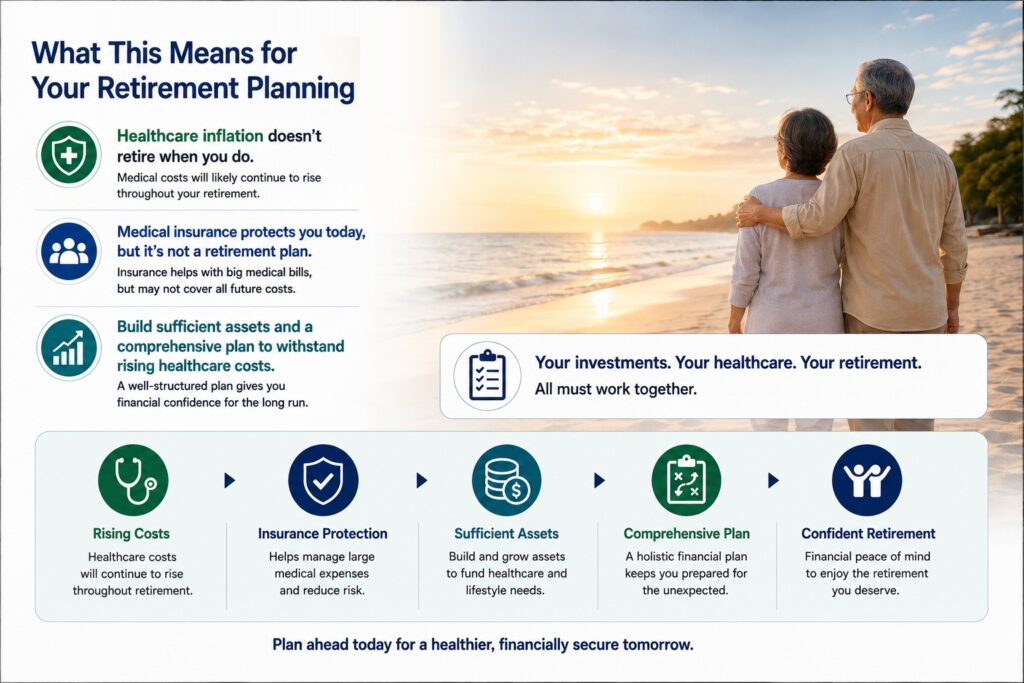
Most Singaporeans I meet have a retirement number. A CPF LIFE payout, a rental yield, a portfolio drawdown figure. It is usually thoughtful, sometimes spreadsheet-perfect. And almost every one of them has built it on a quiet assumption: that healthcare will cost roughly what it costs today. It is the single most expensive assumption in Singaporean retirement planning, because medical costs in retirement do not behave like anything else in your budget.
That assumption is the probably single largest unfunded liability in Singaporean retirement planning. Here is why — and what to do about it.
Before we go further, one question. When your last Integrated Shield Plan renewal notice arrived, did the number give you a jolt? If it did, you are not imagining it and you are not alone — and the reasons run a great deal deeper than one year’s increase.
Part One: How We Got Here
To understand where your premiums are going, you have to understand how the system was built.
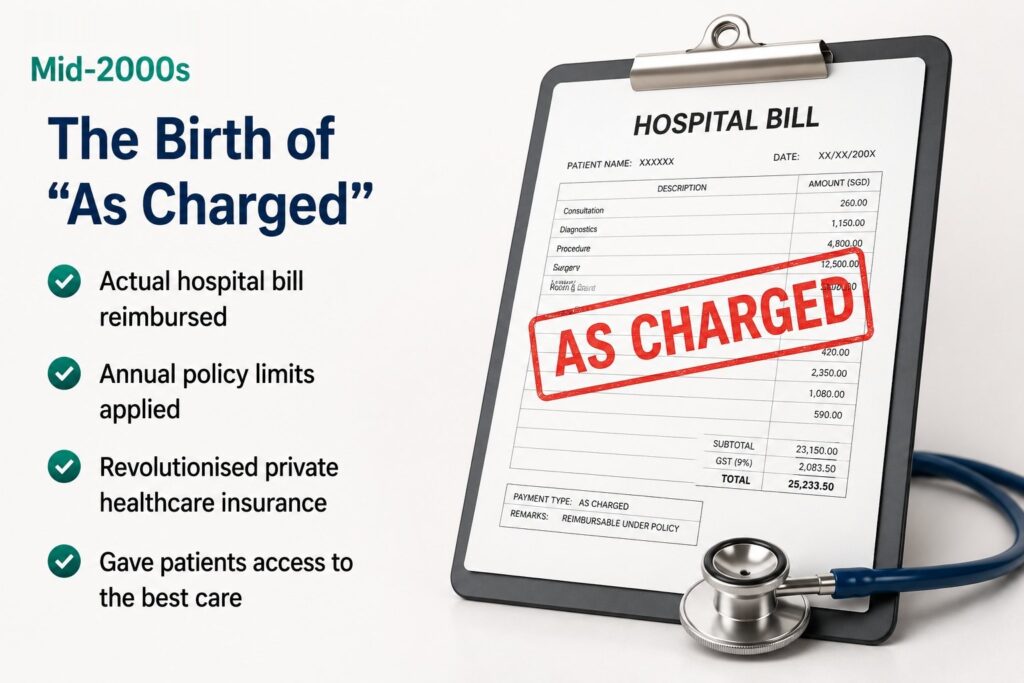
2005 — The “as charged” revolution. Aviva brought the first “as charged” Integrated Shield Plan to Singapore in 2005, removing the inner limits that had previously capped what could be claimed for each procedure. Later, it extended as-charged coverage to outpatient dialysis and cancer treatment.
Competitors matched within months. Inner limits — the old discipline mechanism — largely disappeared for private-hospital plans. It was a genuine breakthrough for policyholders — and it also removed the ceiling on what a hospital bill could be.
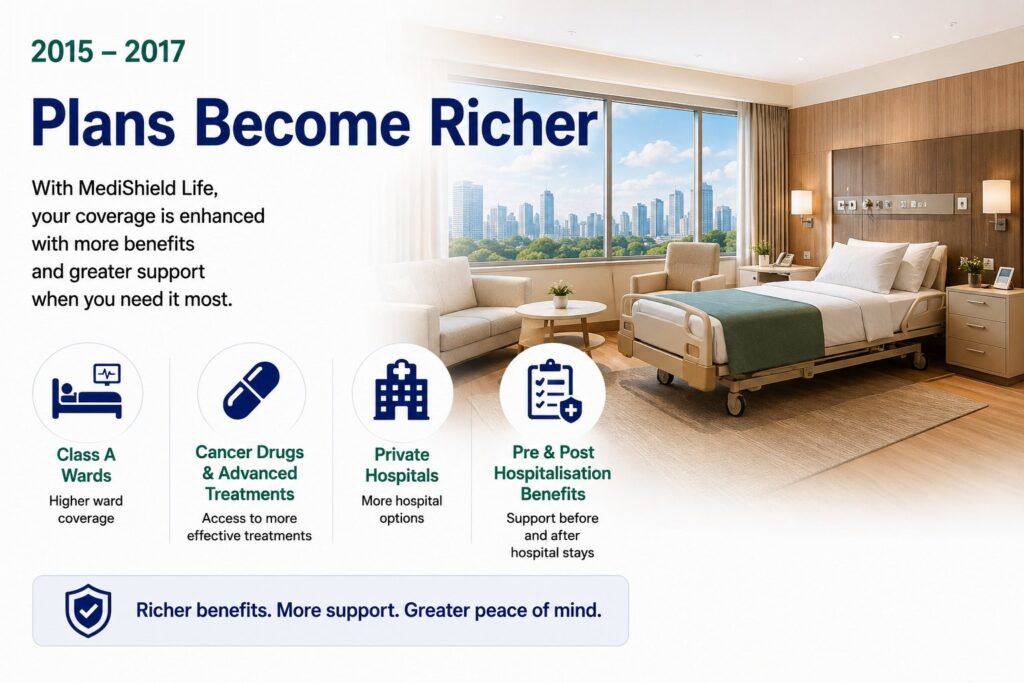
Other insurers enhanced their plans with richer benefits, longer pre- and post-hospitalisation coverage and access to private hospitals.
Consumers benefited tremendously.
However, richer benefits also meant that patients became less sensitive to healthcare costs, while hospitals and specialists invested in newer technology and increasingly sophisticated treatments.
2007–2015 — full riders and the buffet problem
Insurers layered on riders covering both deductible and co-insurance, producing near-zero out-of-pocket hospitalisation. Senior Minister of State Chee Hong Tat later described this as a “buffet syndrome,” leading to over-consumption, over-servicing and over-charging. Insurers then layered on riders that absorbed the deductible and co-insurance entirely. Hospitalisation became, almost free.
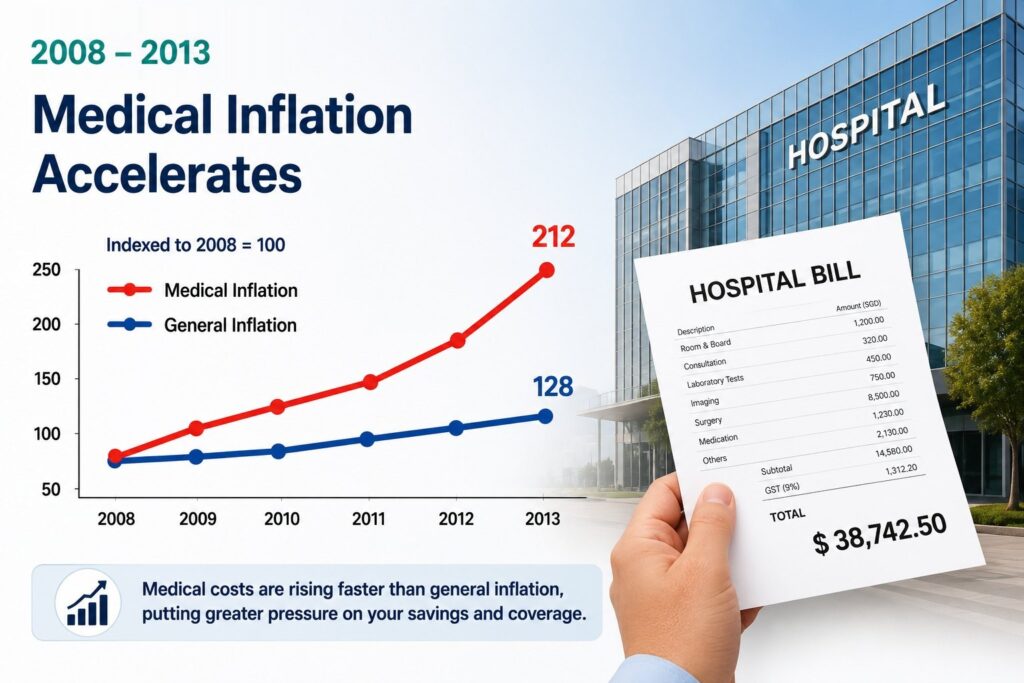
Medical inflation accelerated.
The data eventually proved him right. Between 2015 and 2020, claims incidence grew at a compound annual rate of about 15% for full riders on private hospital plans. For riders with some co-payment, that figure was close to zero. Average bill sizes on full-rider claims ran at least 20% higher.
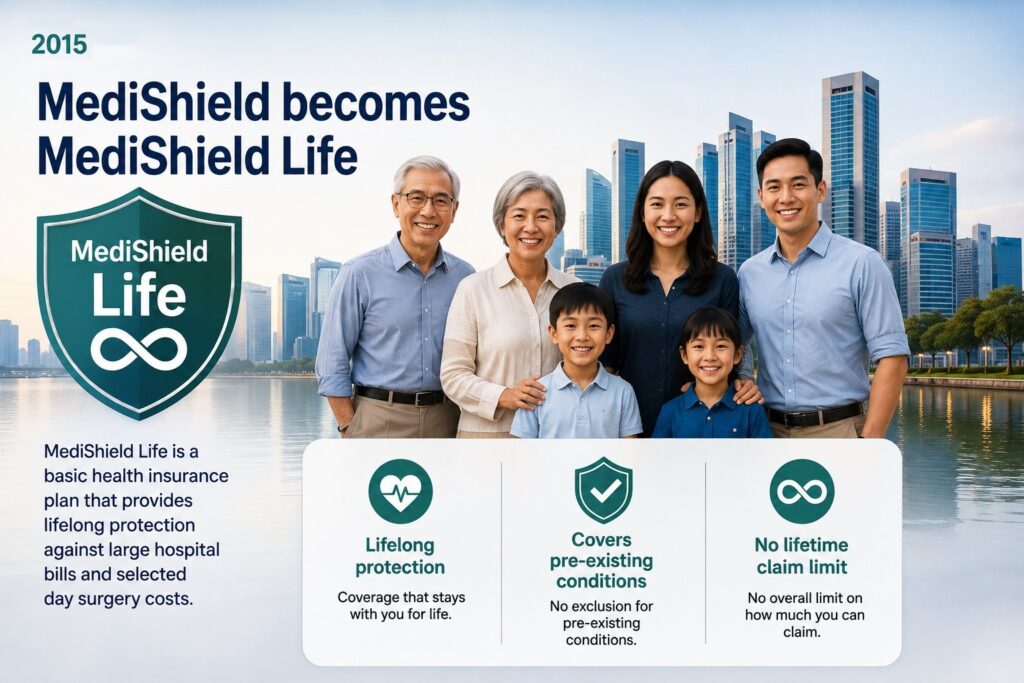
2015 — MediShield Life. The national scheme became universal and lifelong, covering all Singaporeans and PRs including those with pre-existing conditions, who pay a 30% additional premium for the first ten years. The catastrophic layer was nationalised. The layers above it stayed private — and stayed exposed.
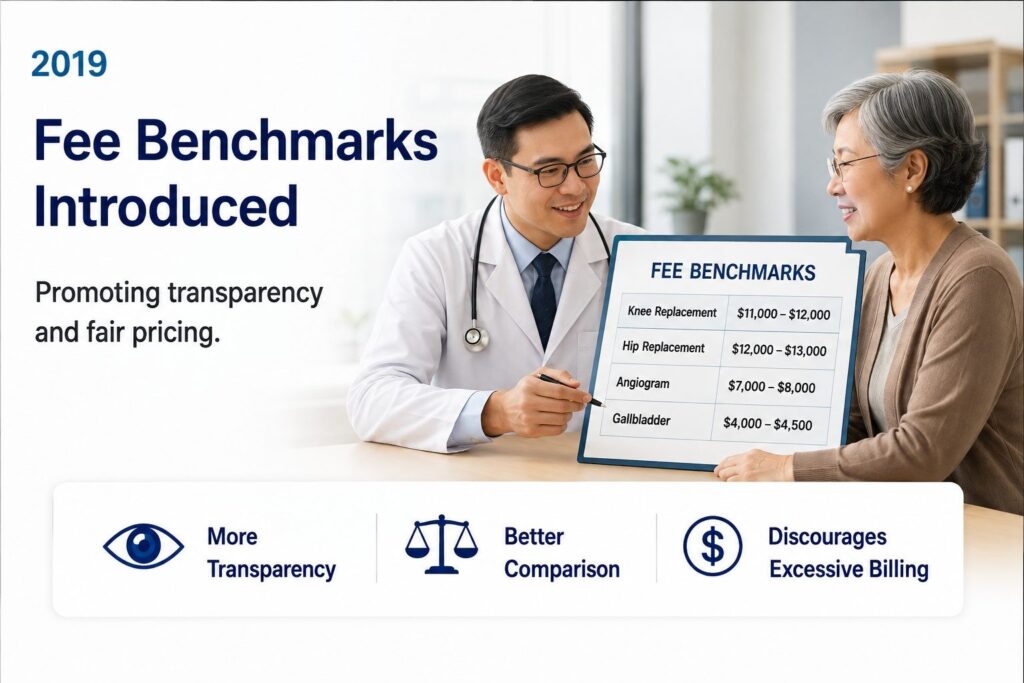
2016 — Health Insurance Task Force, which recommended fee benchmarks, panel networks, pre-authorisation and co-payment. This set the policy direction for everything after.
2018 — The first correction.
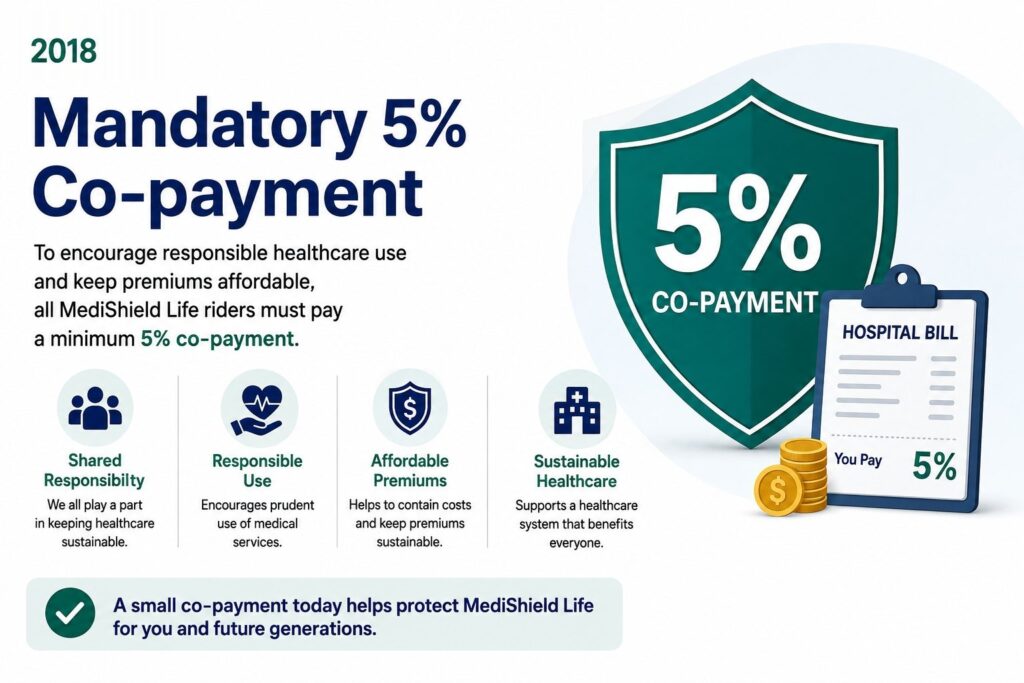
MOH mandated a minimum 5% co-payment on all new riders, capped at S$3,000 per policy year. Full riders stopped being sold. Existing ones were grandfathered, creating a closed block of the highest-utilising policyholders that insurers could no longer re-underwrite — only reprice. I wrote about how those earlier rounds of Shield plan changes played out when the Cancer Drug List was first announced.
The data justifying it: between 2015 and 2020, the compound annual growth rate of claims incidence was about 15% for full riders of private hospital IPs and about 9% for restructured hospital IP full riders, versus close to 0% for riders with some co-payment. Average bill size for full-rider claims was at least 20% higher.
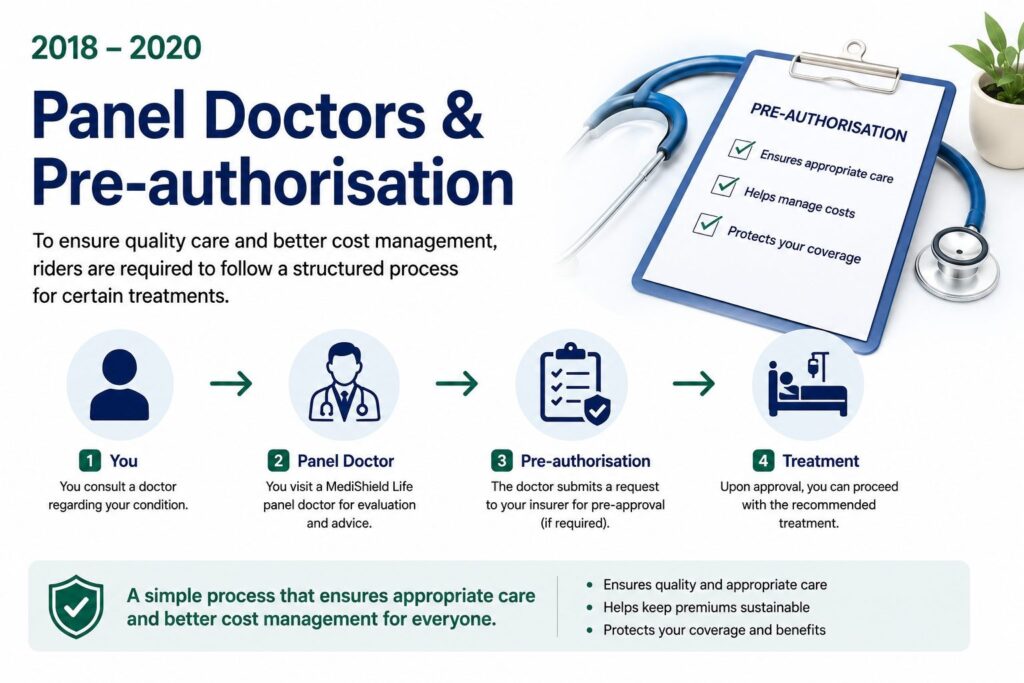
2018 onwards — fee benchmarks, panels, claims-based pricing Insurers rolled out preferred panels, pre-authorisation, and claims-based pricing. Under claims-based pricing, rider premiums at renewal are adjusted based on claims in the previous policy year — with steeper loading for non-panel claims
COVID-19 and the New Reality of Medical Inflation
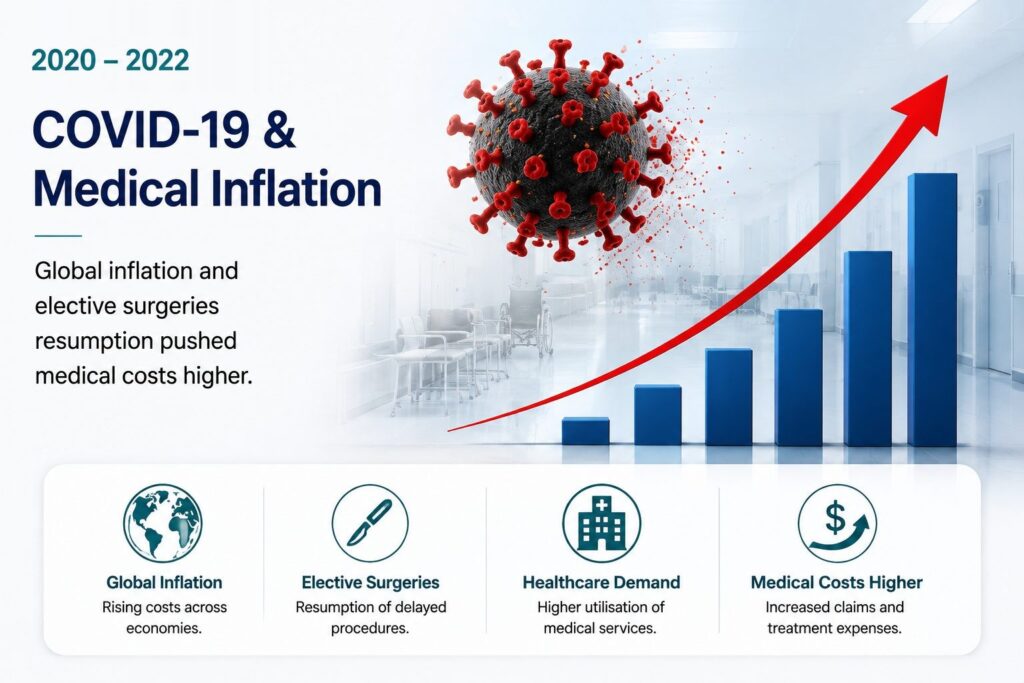
Between 2020 and 2022, two forces collided to push medical costs sharply higher: global inflation and a backlog of elective surgeries. When restrictions eased, hospitals faced a surge of postponed procedures at the same time supply costs, staffing, and equipment prices were climbing worldwide. The result was a jump in healthcare utilisation and claims that insurers — and ultimately policyholders — are still feeling today.
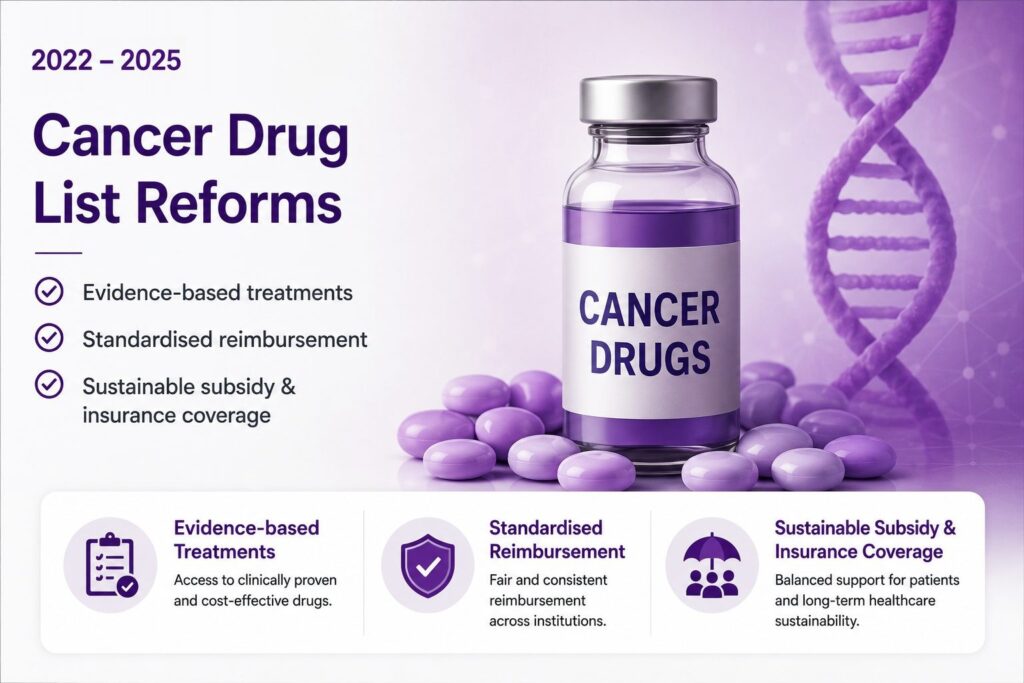
2021–2023 — The Cancer Drug List. From September 2022, MediShield Life and MediSave covered only cancer treatments on an approved list. From April 2023, the same applied to Integrated Shield Plans. Previously, most IPs had covered outpatient cancer drugs “as charged” against policy limits that could exceed S$2 million. That is a very large door that has now closed.
Insurers responded in the only way available to them. Cancer treatment and non-CDL drug coverage moved out of the base plan and into the riders — which quietly changed what a rider is for. It had been a convenience, absorbing your deductible and co-insurance. It became the only thing standing between you and the full cost of a treatment your oncologist recommends but the national list does not fund.
That made riders considerably more essential. It also made them considerably more expensive — and it concentrated the cost in the one component that must always be paid in cash. If the co-payment and panel rules still feel opaque, I have a plain-language walkthrough of how IP riders actually work.
April 2025 — MediShield Life enhanced. Annual claim limit raised from S$150,000 to S$200,000, with higher limits for daily charges, surgery and intensive care. Premiums rise by up to 35%, phased over three years to March 2028, averaging 22% per policyholder. The outpatient deductible arrives 1 June 2026, with the second phase of the inpatient deductible increase on 1 April 2027. The Government is putting S$4.1 billion behind cushioning it.
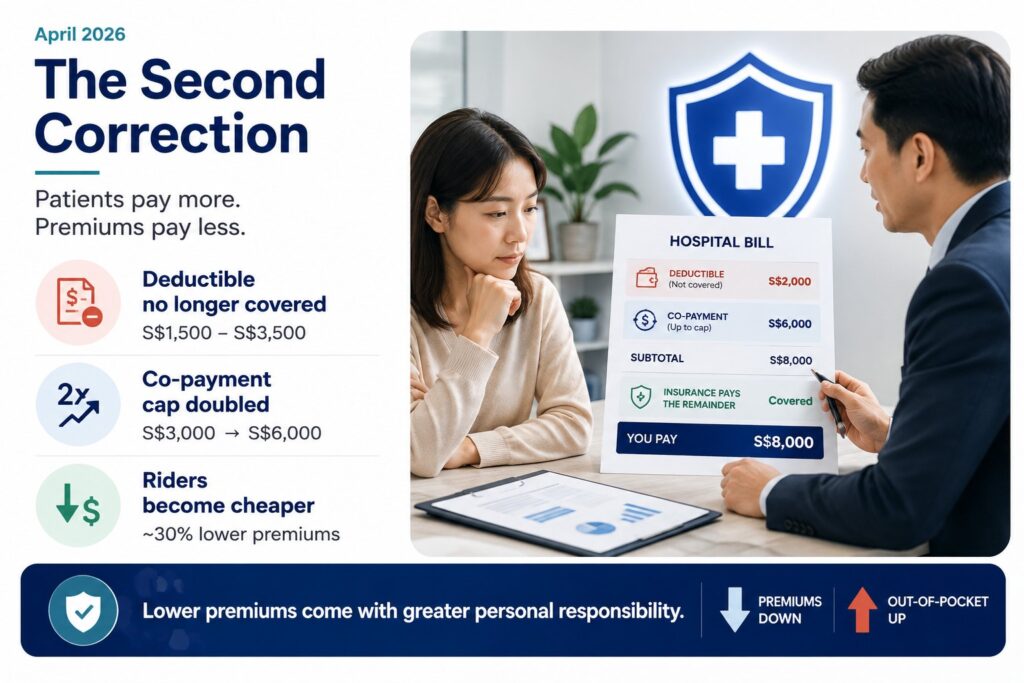
April 2026 — The second correction. New IP riders can no longer cover the minimum deductible, which ranges from S$1,500 to S$3,500 depending on ward class. The co-payment cap doubles from S$3,000 to S$6,000. New private hospital riders are roughly 30% cheaper as a result — because they cover roughly 30% less.
Why Premiums Continue to Rise
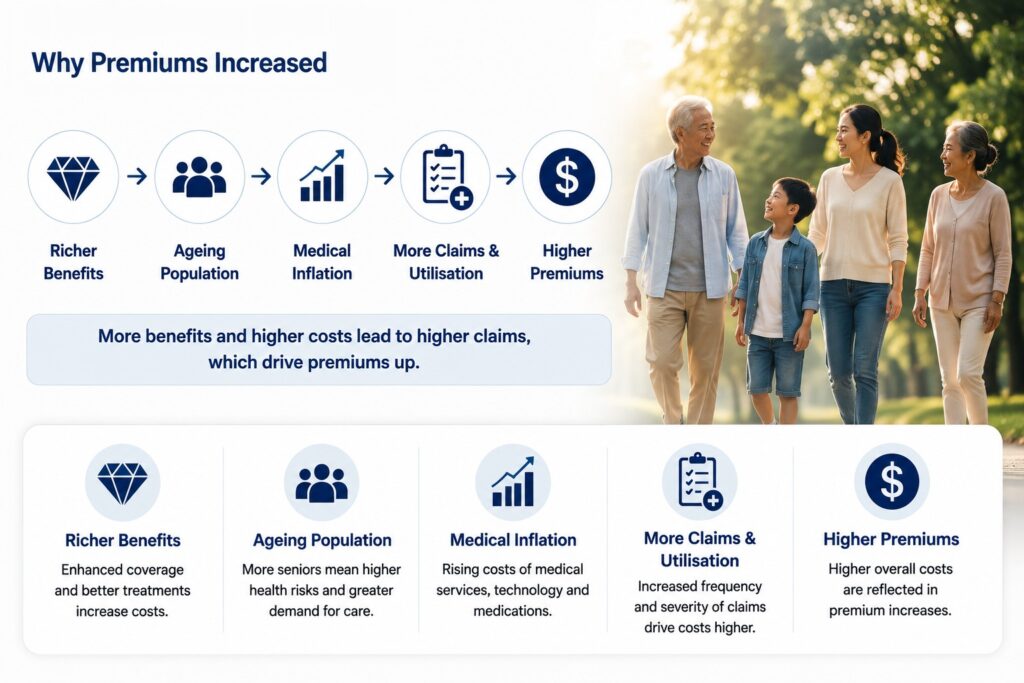
Several factors now work together.
Singapore has one of the fastest ageing populations in Asia.
New medical technology improves outcomes but is more expensive.
Cancer drugs and biologic therapies can cost tens of thousands of dollars.
Hospital operating costs continue to increase.
Doctors and specialists command higher professional fees.
Medical inflation has consistently exceeded general inflation.
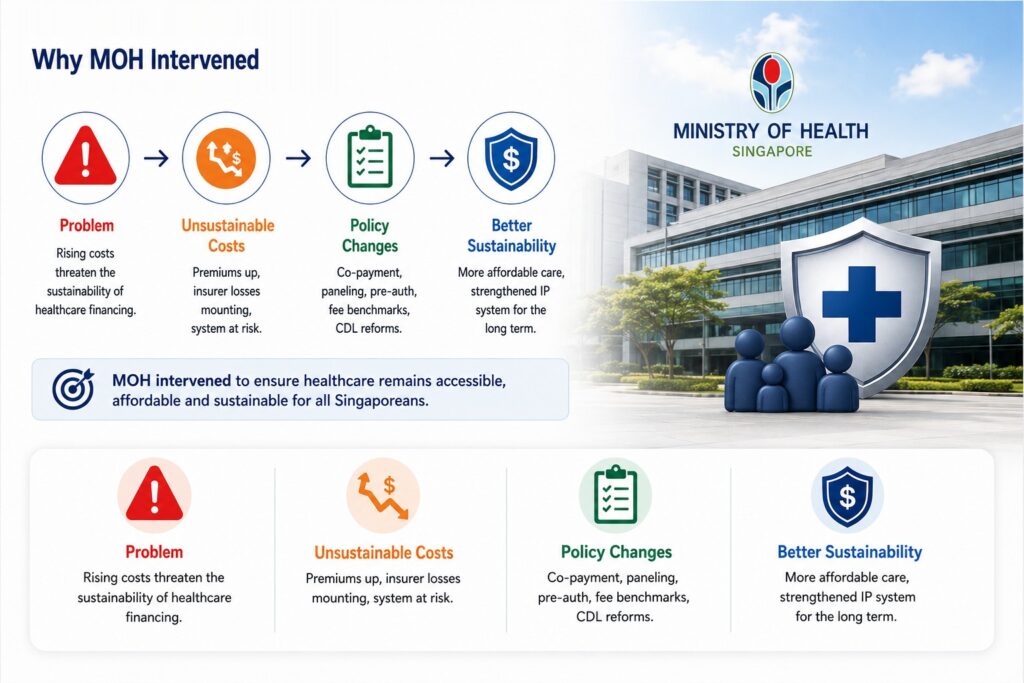
To ensure long-term sustainability, MOH introduced several reforms, including mandatory co-payments for riders, specialist panels, fee benchmarks and tighter reimbursement rules for cancer treatments.
These measures help slow rising claims, but they cannot eliminate medical inflation.
Meanwhile, the insurers have been bleeding
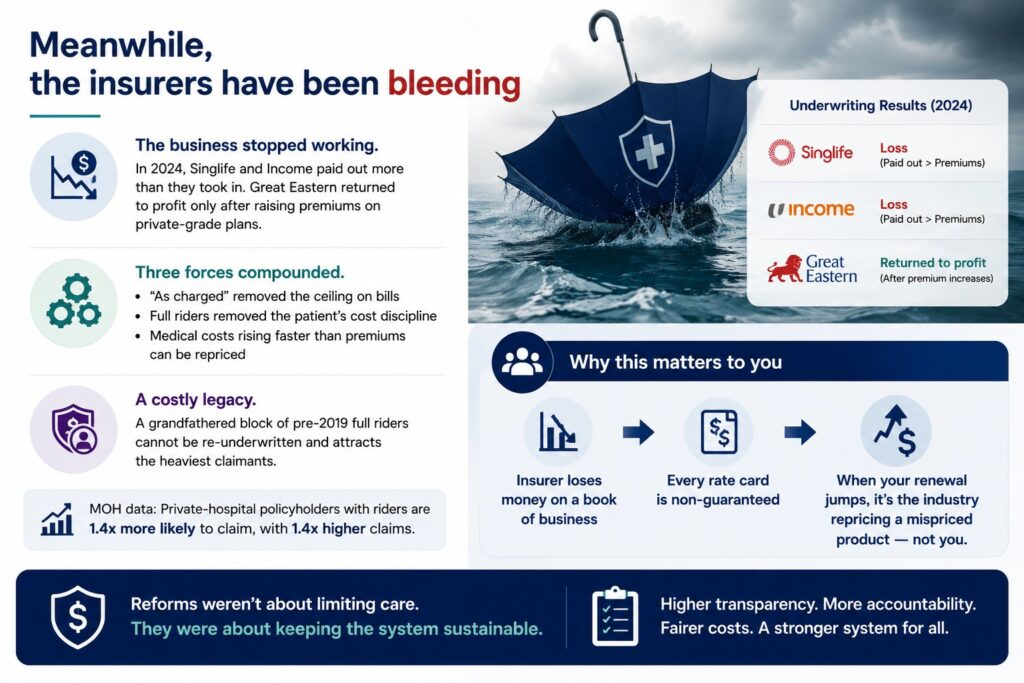
None of these reforms happened in a vacuum. They happened because the business stopped working.
Underwriting results filed with the Monetary Authority of Singapore show almost every Integrated Shield Plan insurer struggling in recent years. Singlife and Income both paid out significantly more than they took in during 2024. Great Eastern reversed its 2023 losses only by raising premiums on its private-grade plans.
Three forces compounded. “As charged” removed the ceiling on what a hospital bill could be. Full riders removed the patient’s reason to care what it was. And medical costs have been rising faster than premiums can be repriced. Layered on top is a grandfathered block of pre-2019 full riders that cannot be re-underwritten and attracts the heaviest claimants. MOH’s own figures show private-hospital policyholders with riders are 1.4 times as likely to claim, with average claim sizes 1.4 times higher.
Here is why that matters to you rather than to shareholders. An insurer losing money on a book of business has exactly one lever, and it is your premium. Every rate card is non-guaranteed. When you open that renewal notice and the number has jumped, you are not being singled out — you are seeing an industry repricing a product that was mispriced for fifteen years.
Part Two: The Escalation, In Numbers
Two different numbers get quoted in this conversation, and confusing them is where most planning goes wrong.
The consumer number. Singapore’s CPI-Healthcare rose 59.1% between 2005 and 2025 — a compound rate of about 2.35% a year, modestly ahead of headline inflation at 2.14%. That sounds manageable. It is also the number that lulls people into complacency.
The insurance number. Medical trend rates — what it actually costs to insure a population, factoring in utilisation, treatment intensity and new therapies — tell a different story. Aon forecast an 11.1% rise across Asia-Pacific for 2025. Mercer Marsh Benefits forecast 12.5% for Asia in 2026, the sixth consecutive year of double-digit trends. The Life Insurance Association Singapore has pointed to Singapore medical costs rising 16.9% in 2026.
The gap between 2.35% and 12% is not a rounding error. It is the difference between a retirement plan that holds and one that doesn’t.
Why the divergence? CPI measures the price of a consultation. Medical trend measures the cost of treating a person — and we are consuming more scans, more procedures, more biologics, and living longer with more chronic conditions while doing it. Your premium is priced off the second number, not the first.
There is a second escalator working alongside it: you also get older. Integrated Shield premiums step up sharply by age band, independently of inflation. A 45-year-old is not simply paying today’s premium plus inflation at 65 — they are paying the 65-year-old premium, inflated for twenty years of medical trend. Two multipliers, stacked.
What that looks like on a real rate card
Let me put actual numbers to it, because the abstraction does not land the way the arithmetic does.
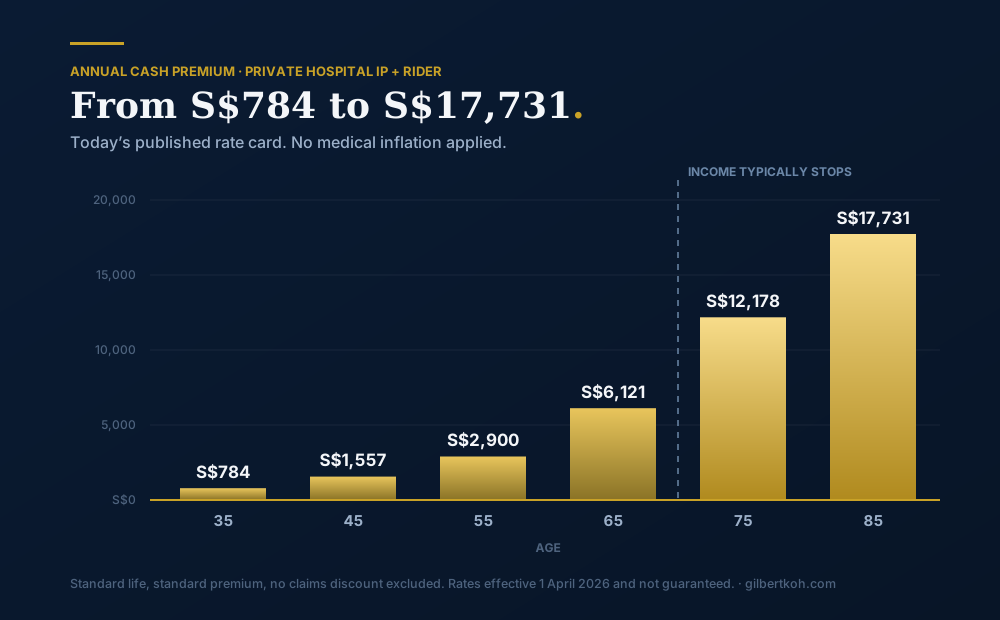
Take a 35-year-old on a private-hospital Integrated Shield Plan with a rider — the standard arrangement for a working professional in Singapore. The figures below are the cash portion of the annual premium, taken from a major insurer’s published 2026 rate card. Not projections. Not estimates. What the table says today.
That is a 22.6-fold increase — and not a single dollar of medical inflation has been applied to it.
This is the number that breaks retirement plans. Nobody budgets a line item that grows twenty-two-fold. People anchor on what they pay today, quietly assume it drifts up with general inflation, and build a retirement number on that assumption.
Two features of this table deserve attention.
First, the shape. The cost does not rise smoothly. It is flat-ish through your thirties and forties, steepens through your fifties and sixties, and accelerates hardest after seventy. Across the full span from 35 to 85, 64% of the total cash cost falls after age 71 — in the fifteen years when employment income has ended and MediSave contributions have stopped.
Second, the cash. MediSave carries the MediShield Life portion and part of the plan premium, but rider premiums must be paid in cash, always. On a private-hospital arrangement, MediSave covers only about a fifth of the lifetime bill. The remainder comes from your pocket, every year, for as long as you live.
Add the two escalators together and the totals are sobering. Summed across ages 35 to 85 at today’s rates, that private-hospital arrangement costs roughly S$331,000 in cash. Apply even a modest 4% annual repricing — well below the medical trend rates cited above, and insurers do reprice — and the lifetime cash figure approaches S$1.5 million.
Figures derived from a major Singapore insurer’s published premium rates effective 1 April 2026, for a standard life on a private-hospital plan with rider, excluding any no-claims discount. Premium rates are not guaranteed and may be revised by the insurer. Your own figures will differ by insurer, plan, ward class, health status and claims history.
Part Three: What Medical Costs in Retirement Do to Your Plan
Here is the uncomfortable arithmetic.
1. Your medical premium is a lifetime liability, not an annual expense.
Most people budget for their Shield plan the way they budget for a mobile plan — a monthly line item. But you will pay this premium every year for the rest of your life, and it will grow faster than your CPF LIFE payout, faster than your bond coupons, and faster than most people’s dividend income.
The table above makes the scale of it concrete. The S$12,178 a year at 75 is the figure worth sitting with — not because it is unaffordable, but because it has to come from somewhere, and in most plans I review, nothing has been set aside for it.
MediSave helps, but MediSave withdrawal limits are fixed dollar amounts that do not index — S$300, S$600 and S$900 a year depending on age — while the premium climbs. And MediSave contributions stop when you stop working. Rider premiums must be paid in cash, always. That is a cash obligation running into your eighties and nineties, at a growth rate you do not control.
2. Your out-of-pocket exposure has been deliberately increased.
From April 2026, a private-hospital policyholder on a new rider faces up to S$3,500 in deductible plus up to S$6,000 in co-payment. Around S$9,500 a year of exposure that no rider is legally permitted to absorb. This is by design — MOH is restoring the price signal.
That is manageable at 45 with an income. At 72, on a fixed drawdown, in a year with two admissions, it is a different conversation entirely.
3. The catastrophic layer is covered. The chronic decades are not.
MediShield Life protects you against the S$200,000 event. Retirement healthcare is rarely one large event. It is fifteen years of specialist reviews, medications, scans, day surgeries, physiotherapy, and eventually help with daily living — the accumulation, not the catastrophe. Almost none of that is what a hospital plan was designed for.
4. Non-CDL cancer treatment is now a cash problem.
The Cancer Drug List has done its job in controlling costs. But if the treatment your oncologist recommends sits outside the list, the funding gap falls to your rider, a critical illness policy, or your savings. For a retiree, “your savings” means selling assets at whatever price the market offers that quarter.
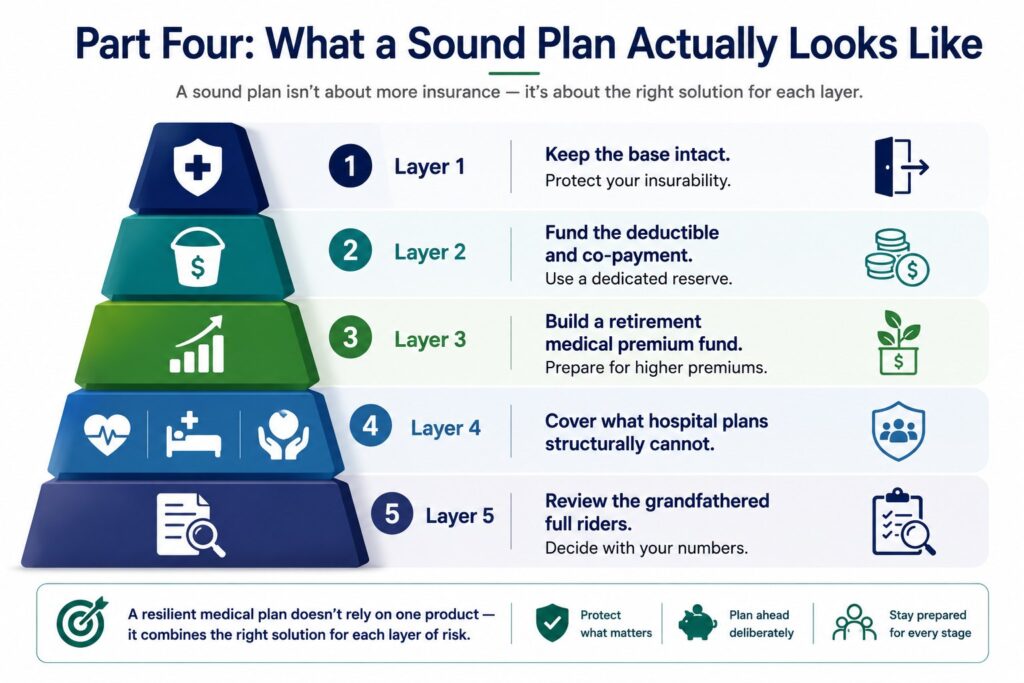
Part Four: What a Sound Plan Actually Looks Like
I do not think the answer is to buy more insurance. I think the answer is to plan for medical costs the way we plan for any other long-duration, inflating liability — deliberately, with the right instrument for each layer.
Layer 1 — Keep the base intact. Never let a Shield plan lapse to save premium. Underwriting is a one-way door; you can always downgrade the ward class or drop to a public-hospital plan, but you cannot buy back health you have since lost. More on this on my health insurance planning page.
Layer 2 — Fund the deductible and co-payment deliberately. Ring-fence a dedicated medical reserve, sized to cover several years of the S$9,500 maximum exposure, held in cash or near-cash. Not “I’ll take it from the portfolio.” Take it from a bucket that exists for exactly this.
Layer 3 — Build a retirement medical premium fund. This is the piece almost nobody does. If your Shield and rider premiums at 70 will be several times today’s figure, that liability deserves its own asset, accumulated during your earning years. An endowment, an annuity stream, or a dedicated portfolio sleeve — the vehicle matters less than the earmarking. This sits inside the wider question of retirement planning, and the earlier you start, the less it costs — as I set out in the cost of waiting.
Layer 4 — Cover what hospital plans structurally cannot. Critical illness for income replacement and non-CDL treatment. Hospital cash for the days themselves. Long-term care — CareShield Life plus supplements — for the years when the problem is not a hospital at all. I have covered CareShield Life and supplements separately.
Layer 5 — Review the grandfathered full riders. If you have held a pre-2019 full rider, you are in the block insurers most want to reprice. Whether to stay or switch depends on your age, your health, and whether you would survive fresh underwriting. That is not a decision to make from a marketing email. It is a decision to make with your numbers in front of you.
The Point
Singapore’s healthcare financing system is one of the best-designed in the world. Every reform since 2018 has moved in one consistent direction: the state guarantees you against catastrophe, and asks you to own the first dollars of your care.
That is sound policy. It is also a transfer of risk — to you, over a retirement that may run thirty years, against a cost curve compounding at double digits.
The plan you built five years ago probably did not price that in. Most didn’t.
Gilbert Koh is an Independent Financial Adviser and MDRT Life Member based in Singapore, representing Avallis Financial. He holds a BBA (Finance) from the National University of Singapore and specialises in protection, wealth accumulation, education and retirement planning for career-progressive Singaporeans and PRs.
Reach him at gilbert@avallis.com
Sources: Ministry of Health Singapore; CPF Board; Singapore Department of Statistics; Aon 2025 Global Medical Trend Rates Report; Mercer Marsh Benefits 2026 Health Trends; Life Insurance Association Singapore. Figures accurate as at July 2026. This article is for general information and does not constitute financial advice. Please seek advice tailored to your circumstances before making any decision.
If you hold an integrated shield plan in Singapore, changes to what’s covered can quietly affect your out-of-pocket costs — here’s the latest update.
As you may be aware, the Ministry of Health (MOH) recently released a list of cancer drugs that will be covered by MediShield Life and other integrated shield plans. The list includes both generic and branded drugs, and covers a range of cancer types, from breast cancer to lung cancer.
The inclusion of these drugs on the list is a significant step towards ensuring that cancer patients receive the treatment they need without facing undue financial burden. However, it is important to note that not all cancer drugs will be covered by your integrated shield plan. If you are currently undergoing cancer treatment or are simply concern with adequate coverage for cancer treatment, it is important to review your plan and understand the coverage available to you.
We understand that cancer can be a challenging and difficult disease to navigate, and we want to ensure that you have the information and resources you need to make informed decisions about your healthcare.
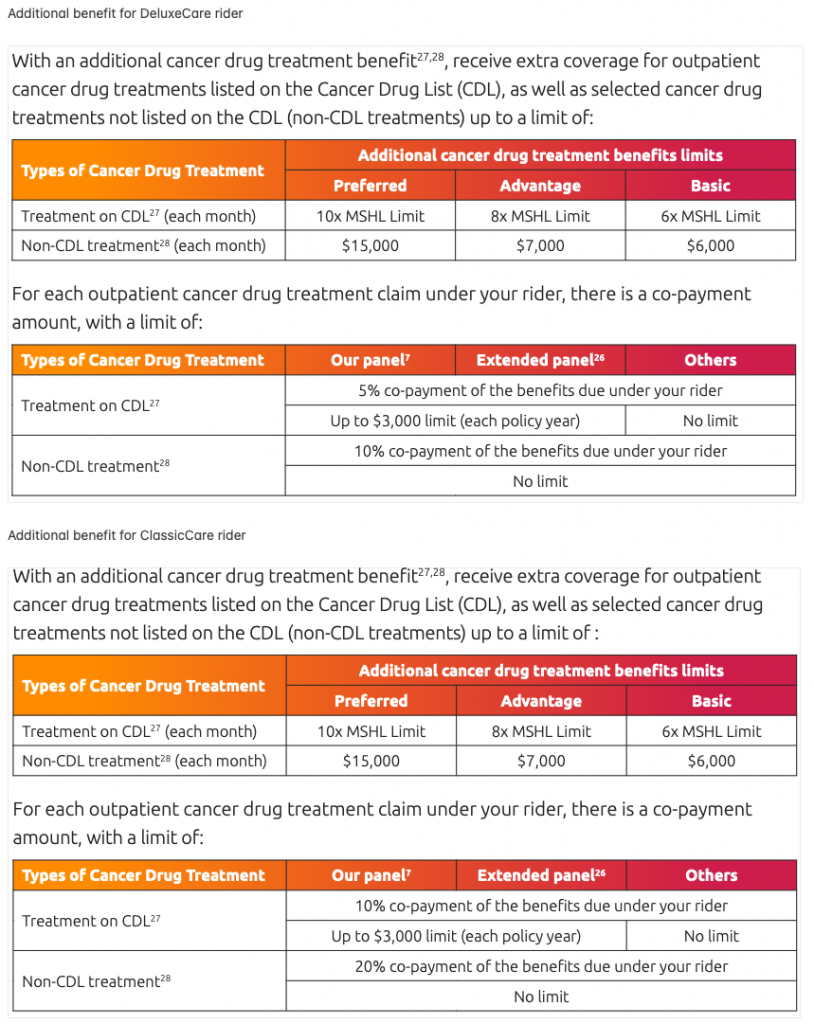
– a new outpatient Cancer Drug Treatment benefit and
– Cancer Drug Services benefit.
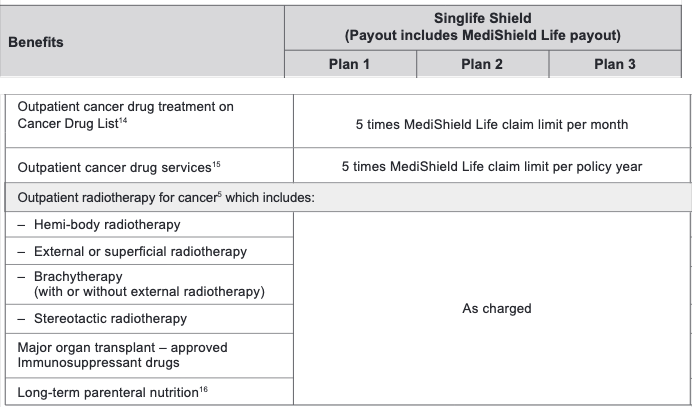
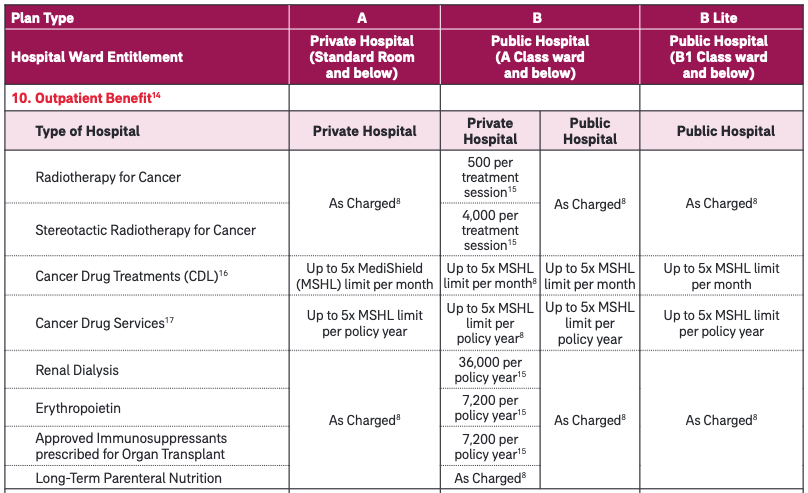
• Cancer Drug Treatment benefit (CDT) – Only outpatient cancer drug treatments on the CDL will be claimable under your Policy, up to the treatment-specific benefit limits. Selected outpatient cancer drug treatments beyond the CDL will be claimable under riders. If you require cancer treatment following the changes, please consult your doctor early on whether your treatment is on the CDL.
• Cancer Drug Services benefit (CDS) – Services that are part of any outpatient cancer drug treatment (including treatments not on the CDL), such as consultations, scans, lab investigations, treatment preparation and administration, supportive care drugs and blood transfusions, will be claimable under the Cancer Drug Services benefit, up to specified benefit limits.
Changes to the IP plan by the various insurers are as follows
Main plan
Singlife ( known as Aviva previously)
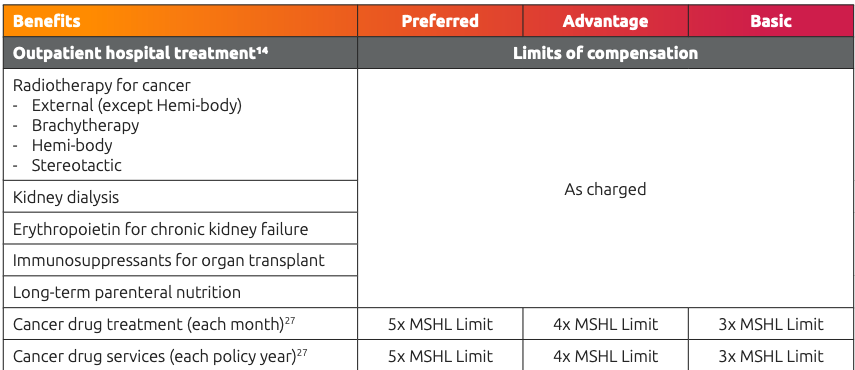
up to 5x Medishield Life claim limits for CDT (CDL) and CDS
AIA
– up to 5x Medishield Life claim limits for CDT (CDL) and CDS
Income
– ranges from 3 to 5x Medishield Life claim limits for CDT (CDL) and CDS depending on the plan
HSBC (known as AXA previously)
– ranges from 2 to 5x Medishield Life claim limits for CDT (CDL) and CDS depending on the plan
Next, IP riders
Singlife
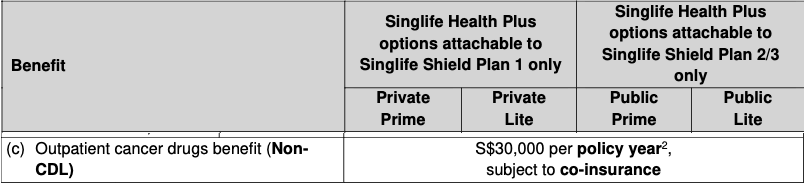
Existing rider does not boost limits for CDT (CDL) nor CDS. However, it includes a benefit for CDT (Non-CDL)
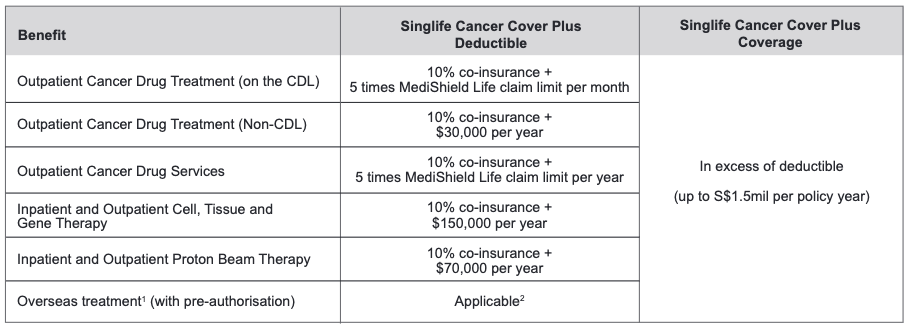
Introduced a New Cancer Cover Plus rider
boost the limits for CDT (CDL) and CDS and includes a benefit for CDT (non-CDL)
benefit limits are on As Charged basis up to S$1.5mil/yr, subject to plan deductibles and co-insurance
you can apply for the rider, subject to health underwriting and additional premium
Note : this rider can be purchased to complement IP policies issued by third party insurers
Existing rider seeks to cover part of the deductible and co-insurance for CDT (CDL) and CDS
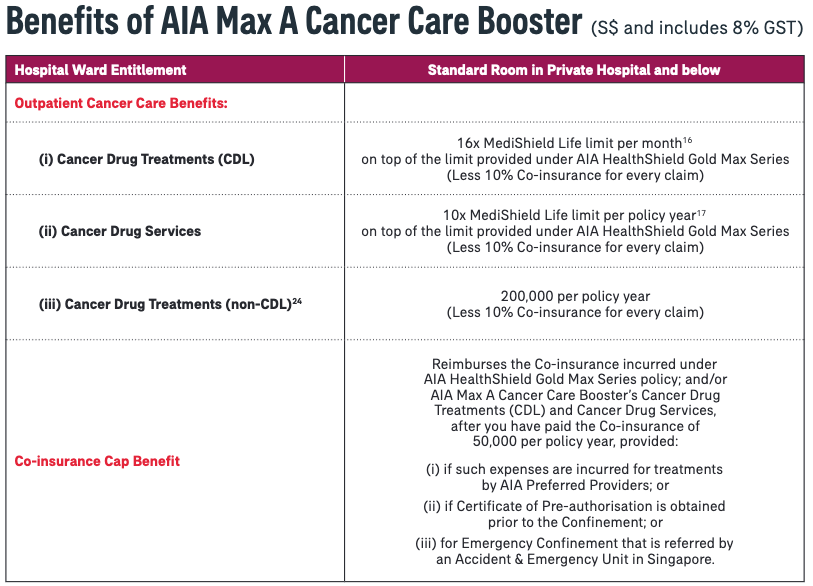
New Cancer Care Booster rider
Boosts the limits for CDT (CDL) and CDS and includes a benefit for CDT (non-CDL)
this rider will be automatically added to your policy upon renewal without need for health underwriting but will be subject to additional premium. You can choose to opt out.
Income
– Existing rider boosts the limits for CDT (CDL and Non-CDL). Nothing for CDS
– No new rider
HSBC
Existing rider boost the limits for CDT (CDL) and includes a benefit for CDT (non-CDL)
No new rider
In summary
IP main plan does not cover CDT (non CDL)
Cancer treatment is no longer on As charged basis and shall be catagorised into CDT (CDL) and CDS and shall be subjected to certain benefit limits.
Main concern for policyholders will be the uncertainty on whether the CDT and CDS limits are adequate and whether it’ll be adjusted for inflation down the road.
To address these concerns, Insurers have either enhanced existing riders or introduced new riders. Personally, I’ll encourage to apply for the rider especially if you’re on a private hospitalisation plan. However, new riders may be subject to health underwriting and additional premiums
Perhaps an additional solution may be through a life plan with critical illness cover
Switching of IP insurer is highly discouraged especially if you have any pre-existing medical conditions
IP plans have gone through significant changes over the years (e.g removal of full cover riders and introduction of panel specialists and pre-authorisation) and I foresee that it will get increasingly more complex
If you have any questions about your coverage or would like to discuss your options, please get in touch with your trusted adviser.
Managing your finances during a crisis in Singapore comes down to a few basics that hold up regardless of what’s making headlines.
The PM speech yesterday is a sobering reminder that the Covid-19 threat, now being a global pandemic, is far from over and we can expect to see a spike in infections and perhaps deaths. While our government can put in all the necessary measures to contain and eradicate the virus, it also boils down to the social responsibility of the individual to exercise personal hygiene and self-isolation if feeling unwell.
But having said that, life goes on, just with some added precautions.
On the Financial front, what actions should you take in light of the prevailing situation? Well, here are my suggestions:-
1. REFINANCE YOUR HOUSING LOAN – to address a global slowdown, countries will probably inject liquidity into the system and that’ll drive interest rates lower – Hence, there’s no better time to seek lower housing loan rates – we deal with mortgage brokers in this area and they’ll help you secure the most appropriate loan packages for you, hassle-free
– Do get in touch if you’re keen to explore
2. INSURANCE PROTECTION – this is pretty obvious. If you have been procrastinating to insure you and your family, there’s no better time than now to take action. If a pandemic happens in S’pore, insurers may hike premiums and/or tighten their underwriting, so lock-in your relatively low premiums now and secure your coverage in the interest of your family
– Do get in touch if you’re keen to explore
3. REDUCE DISCRETIONARY EXPENSES AND BUILD CASH RESERVES – this is especially true for self-employed or entrepreneurs whose earnings can be affected by the economic slowdown
4. CONTINUE TO SAVE & INVEST FOR RETIREMENT
– Deploy surplus cash reserves and monthly surplus cashflow to generate higher yield in order to achieve your accumulation goals, whether it’s for wedding, child’s tertiary education or retirement.
– I’ve been a strong advocate for endowment savings type plans as most clients will benefit better with a hassle-free approach to generate a respectable return of about 4%p.a with capital guaranteed, for their wealth accumulation.
– On investments, you can benefit from our company structured portfolios with regular review and rebalancing provided. To better ride through market volatility, it takes a long term horizon, nerves of steel and a dollar-cost averaging strategy to achieve your accumulation goals.
– Do get in touch to find out more and to review your investment portfolio
5. BOTTOM FISH THE MARKET
In the above screenshot, you will observe that major markets have dropped 25-35% within just 1 month. Taking reference from the U.S market, it has wiped out the entire 2019 gain in just 1 month!
So are there still opportunities to buy? Certainly!
Invest now? To be advised…
Do email me to register your interest so that when the opportunity presents itself, you’ll be among the first to get notified
A. Company managed portfolios
Minimum investment – S$10k (recommend at least $50k)
Recommended monthly investment – at least S$1k/mth
B. Tactical Portfolio strategy (only for experienced and responsive investors) Minimum investment – S$200k Cash only
This is not a time to be passive but rather to take proactive action to secure your long term interest. Look forward to hear from you.
Meantime stay safe and positive always….
If you know any colleagues, friends, parents or relatives who would like to benefit from the above, your kind introduction will be appreciated and feel free to forward this article.
Hospital insurance riders in Singapore can feel like a maze of co-payment percentages and panel restrictions — here’s a plain-language walkthrough.
IMPORTANT : This is particularly relevant to those who have a private hospitalisation plan AND
– have an option C rider under Aviva Myshield (regardless of when it was purchased) OR – purchased full cover IP (Integrated Shield Plan) riders with any insurer on or after 8 Mar’18.
With the exception of Aviva, for those who bought IP riders before 8 Mar’18, you will continue to enjoy your rider with benefits unchanged. For Aviva policyholders, pls see “New Aviva Option C rider” below.
For those who bought full cover IP riders between March 8 last year to March 31 this year, your plan will transition to the new co-pay riders upon the renewal of your policies from April 1, 2021.
NEW Co-pay riders (how it works in general)
So how does the new co-pay riders look? Depending on which insurer and plan (we will assume private hospitalisation for discussion purpose) you are with, it may have the following features :-
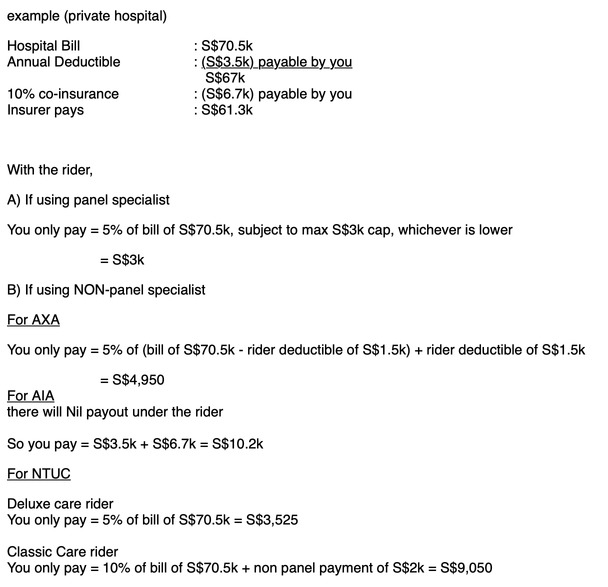
1. 5% co-payment by you subject to a cap of S$3k/yr if you are using the insurer’s panel of specialists. No cap if using non-panel
2. AXA, Aviva and NTUC require an additional rider deductible to be payable by you if using non-panel specialist
3. AIA rider will not cover main plan deductible and co-insurance at all if using non-panel specialist
This is applicable if you bought the option C (combination of option A + option B) rider before 8 Mar’18. This rider will be effective upon your policy renewal in 2019. – there is now a rider deductible payable by you as highlighted in the table below (Existing MyHealthPlus column) – amount of rider deductible is dependent on whether panel specialist is used &/or pre-authorisation is given. Please refer to the table below- “Existing Myhealthplus” column.
New Aviva Option C rider (pls refer to Existing MyHealthPlus column in the table below)
New Aviva Option C II rider This is applicable if you bought the option C (combination of option A + option B) rider on or after 8 Mar’18
Essentially, the Option C II rider covers – the main plan deductible after you pay a rider deductible (pls refer to above table, “New MyHealthPlus” column) – 50% of the main plan co-insurance (your exposure is cap at S$3k if using panel specialist with pre-authorisation, otherwise no cap)
Insurer panel of specialists and pre-authorisation
In practice, on the issue of using the insurer’s panel of specialists and pre-authorisation, there may be a tendency for policyholders to overlook this as the specialist they see will often be referred by their GP or referred by their friends. Hence, there’s a possibility that your preferred specialist may not fall under the insurer’s panel.
This concern is real as I’m usually informed by my clients on their impending hospitalisation or surgery just days before the surgery or hospitalisation.
Moving forward, pls use the insurer’s panel of specialist (click on the link)
Raffles Shield in Singapore was the seventh Integrated Shield Plan to enter the market — here’s how it compared when it launched.
RafflesHealthinsurance(RHI) , a fully owned subsidiary of Raffles MedicalGroup, announced the launch of Raffles Shield, making it the seventh player to enter the industry. Raffles Shield is the first Integrated Shield Plan (IP) developed in collaboration with Raffles MedicalGroup and is a Medisave- approved IP providing coverage for hospital and surgical expenses.
Raffles Health insurance has observed that many who purchase IPs are keen to have private hospital coverage without overly expensive premiums, and would like to have more flexibility to manage their premiums. In response to this, Raffles Shield offers two attractive options
1. the Raffles Hospital Option
– typically, one has to decide between choosing a private hospital plan vs a government restuructered hospital plan and the decision basically comes down to affordability of premium.
With Raffles Shield howver, it offers an hybrid option where a government restructured hospital plan is combined with a Raffles Hospital option at an afforable premium without any pro-ration being applied.
2. the High Deductible Option (HDO)
– whereby instead of the usual S$1.5k-3.5k annual deductible, one can opt for a S$10k annual deductible in exchange for a lower premium.
This works especially well in situations where the insured is aleady covered by existing employee benefits and thereby avoids duplication of cover and paying excessive premium at the same time. When you feel the need to have a smaller deductible, just remove the HDO anytime during policy renewal without any medical underwriting!
Pre-existing medical conditions
Typically, hospital type insurance plans have the strictest level of underwriting whereby if one has a pre-existing medical condition, a health exclusion can be commonly expected.
Hence, another unique feature of the plan is that it might be able to offer coverage to individuals with certain pre-existing conditions and work with them through the Raffles Care Management Program to improve their overall well being.
To find out more about the plan and seek independant advise on which plan option suits your needs best, just get in touch wth me at gilbert@avallis.com
Travel insurance Singapore travellers often skip is one of the cheapest add-ons to a trip — and one of the most regretted skips when something goes wrong.
Going on a vacation?
It’s undoubtedly the top past time for busy working Singaporeans whenever we can can afford it or have time for.
A good vacation can involve much time involved in planning especially for free and easy multi-week vacations across Europe, U.S.A or Japan and can amount easily to a tidy five figure sum.
Now with your plans all finalized, leave applied and approved, flight and accommodations all paid, what’s next? Insure it of course!
Insurance is often an after thought or not consciously incorporated in one’s travel plan when it should, shouldn’t it? After all, what happens if the travel agency closes down before you travel (I’m sure you’ve read such horror stories in the papers)? What if a close family member falls ill and you need to cancel your trip? lose your passport or have your money stolen? lost luggage? fall ill and require hospitalization? and the list of possibilities goes on…and your vacation can turn out to be a real nightmare.
In such circumstances, you’ll be glad that you had bought a travel policy to insure against these and more. After all, the cost of insuring is insignificant relative to the cost of your vacation and the amount of time and effort put into planning, so the only logical decision is to get insured, isn’t it?
So now that you’ve decided to secure a travel policy, next question is, does it cover my pre-existing medical conditions?
Most insurers will not cover pre-existing medical conditions which means that if you have high blood pressure and you suffered a stroke whilst overseas and need emergency hospitalisation or medical evacuation back to Singapore, sadly you’re on your own…well until now.
An insurer has just launched a travel policy that will cover your pre-existing medical conditions, thereby giving you greater security and peace of mind. However, it comes with a caveat – there’s 50% co-payment or lower insured limits for certain benefits, and comes at a higher premium of course.
Notwithstanding, it’s an excellent option that is now available when previously there was none.
To find out more, just drop me a note on the right and we’ll get in touch soon.
The protection gap in Singapore works a lot like the one between the MRT platform and the train — small, easy to ignore, and genuinely dangerous if you fall into it.
Have you taken a subway in UK or the MRT in S’pore?
If you have, you would have noticed signs & floor markings cautioning you to “Mind the Gap” between the boarding platform and the arriving train to prevent any mishaps. In spite of the warnings, unfortunate incidents have occurred where individuals actually fell onto the track or had their limbs trapped in the gap. Hence, it’s best to heed the warnings or ignore them at one’s peril, wouldn’t you agree?
Not adequately addressing these financial gaps can expose one and one’s family to serious consequences.
Such examples would be:-
– financial distress caused by loss of income due to illness and accidents
– burdened by large medical bills
– not having sufficient resources to provide the best education for one’s child
– not having adequate resources to outlast your retirement or live the retirement lifestyle you desire
– leaving an inadequate estate to your loved ones (e.g loss of a breadwinner may force the surviving spouse to take a second job in order to support the family)
But how would one be able to identify where their gaps are, the size of the gaps, how best to prioritize one’s resources to address the gaps and what’s the best way to close up the gaps?
In my work with my clients, my role will be to guide them through the process and help them obtain the answers to the above questions. Finally, by implementing the financial plan recommendations, I’m confident that they will achieve greater peace of mind knowing that they have done their up most best to close up their financial gaps in order to protect theirs and their family’s long term interest.
If surplus financial resources are available, why leave things to chance?
The choice is either to pay a small price today to address one’s financial gaps or potentially face a significantly higher price later on in life due to inadequate planning
Indeed, how well we can overcome the financial hurdles in life often depends on the choices we make today….and there’s no better time to plan than Now.
To seek advise on the above or to refer a friend, just email me on the right side and we’ll get in touch soon.
Till then… Live life to the Fullest, without Regrets!
“MEN in Singapore have the second highest healthy life expectancy in the world and women the fourth highest…..But these longer healthy lives also come with longer years of disability”
“A boy born here in 2010 can expect to live 68.1 years in good health and 10.7 years coping with serious disability.
“A girl can expect 70 years of healthy life and 13.3 years with poor health”
“Women are hit especially hard by disability. Women aged 15 to 65 years lose more healthy life to disability than men.”
Should health fails and your income ceases, how much are you willing to drain your reserves to fund your healthcare cost? how will you continue to care for your family and fund your financial commitments?
Do you have disability insurance? Do you realize that many disability situations will not satisfy a Death, TPD or Critical Illness claim? i.e none of your existing policies will offer a payout. Hence, not having one is akin to trying to shield you and your family with an umbrella with gaping holes or caring for them in a house with a leaking roof.
Would you do that to your family?
To seek advise on the above, just send me an email on the right and we’ll get in touch soon.